










FinOps for AI Tokens: Why the Rules Changed — and What to Do About It
Read more

What are Kubernetes Cost Management Solutions?
Kubernetes cost management solutions involve a combination of strategies and tools to monitor, analyze, and optimize cloud spend. Key solutions include tools for granular cost allocation and reporting, automating resource rightsizing and scaling, detecting idle or over-provisioned resources, and implementing best practices like resource cleanup and workload placement optimization.
Many Kubernetes cost management platforms provide dashboards and reporting features to visualize where cloud spend is happening within clusters. They often integrate with existing monitoring and observability tools, allowing users to correlate cost with performance data and application metrics. This supports better decision-making for budgeting, forecasting, and continuous optimization in cloud-native environments.
Editor’s note: Updated the article to cover recent Kubernetes cost management market trends, updated information about cost management solutions to reflect features and capabilities in 2026, and added one new solution.
This is part of a series of articles about Kubernetes Cost Optimization.
 Kubernetes Cost Management Market Trends
According to recent market research, the Kubernetes cost management market is expanding and driven by the increasing need to control cloud spending. It is valued at $1.75 billion in 2025 and expected to reach $5.78 billion by 2030. This growth is linked to widespread Kubernetes adoption, rising cloud costs, and limited visibility into spending across teams and namespaces.
Key Growth Drivers
Several factors are pushing demand for Kubernetes cost management solutions. The shift to microservices and Kubernetes-based architectures has increased system complexity and cost variability. At the same time, organizations are facing frequent budget overruns due to poor visibility into resource usage.
The rise of multi-tenant platforms and platform engineering teams also contributes to demand. These environments require precise cost allocation and governance to manage shared infrastructure effectively.
Emerging Trends
New capabilities are shaping how cost management tools evolve. AI-driven anomaly detection is being used to identify unusual spending patterns. Tools are also integrating more deeply with cloud billing systems and tagging frameworks to improve accuracy.
Other trends include real-time cost allocation, automated rightsizing, and tighter integration with autoscaling systems. There is also growing adoption of FinOps practices, which bring financial accountability to engineering teams managing Kubernetes environments.
Rising infrastructure costs, including tariffs on hardware, are influencing the market. Higher costs for compute, storage, and networking equipment are pushing organizations to delay expansion and focus more on efficiency.
Multi-Cloud Adoption As A Catalyst
The shift toward multi-cloud strategies is a major driver of market growth. Organizations are increasingly running workloads across multiple cloud providers to improve flexibility and resilience.
Kubernetes cost management tools support this by providing unified visibility across environments. They help track spending, optimize resource usage, and prevent budget overruns, even when workloads are distributed across different platforms.
Notable Kubernetes Cost Management Solutions
Finout

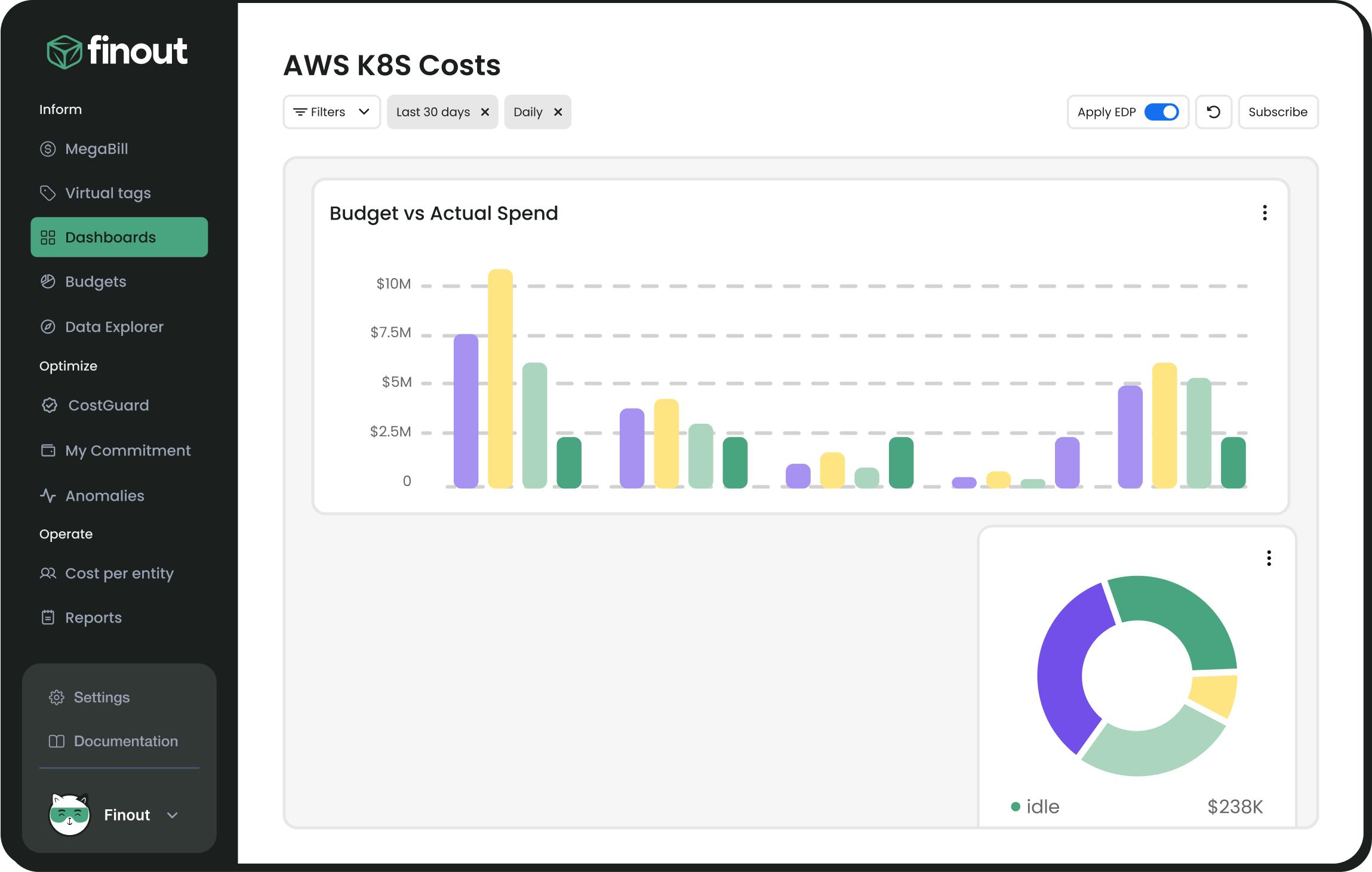
Finout is an enterprise-grade FinOps platform that provides a unified "MegaBill" to manage Kubernetes costs alongside all other cloud and SaaS expenses. Unlike tools that require heavy in-cluster agents, Finout leverages existing monitoring data (like Prometheus or Datadog) to provide 100% cost allocation without changing code or adding operational overhead.
Key features include:
- The MegaBill: Consolidates Kubernetes costs with other cloud services (AWS, GCP, Azure) and SaaS tools (Datadog, Snowflake) into a single view, allowing teams to see the "true cost" of a business unit or product.
- Virtual Tagging: Enables granular cost allocation by pod, namespace, or label across all providers. Virtual Tags allow you to fix inconsistent tagging retroactively without having to manually retag resources in your cloud console.
- CostGuard optimization: Automatically scans Kubernetes clusters to identify CPU and memory waste. It provides actionable rightsizing recommendations and simulates potential savings before you apply changes.
- Agentless integration: Connects natively to your existing observability stack (Prometheus, Datadog) to pull metrics, eliminating the need to install and maintain additional agents within your production clusters.
- Shared cost reallocation: Advanced logic for distributing unallocated or shared costs—such as idle cluster capacity or support fees—proportionally across teams or projects based on actual consumption.
Source: Finout
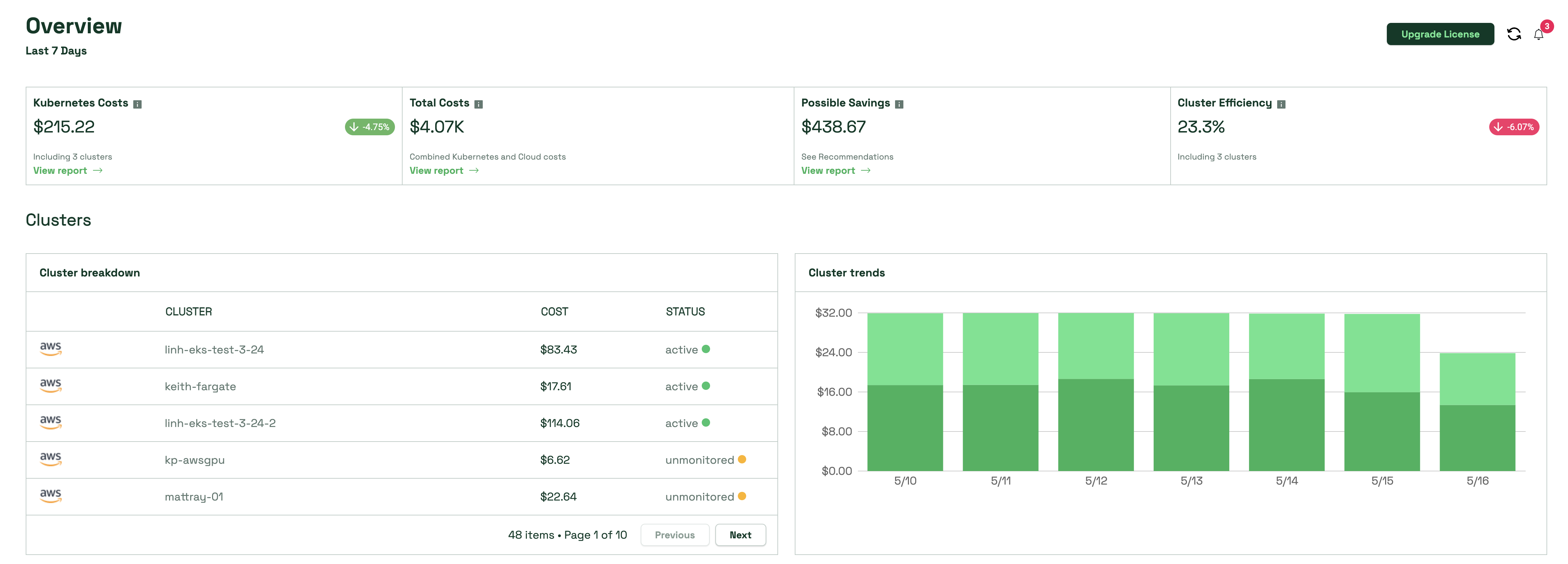
Kubecost

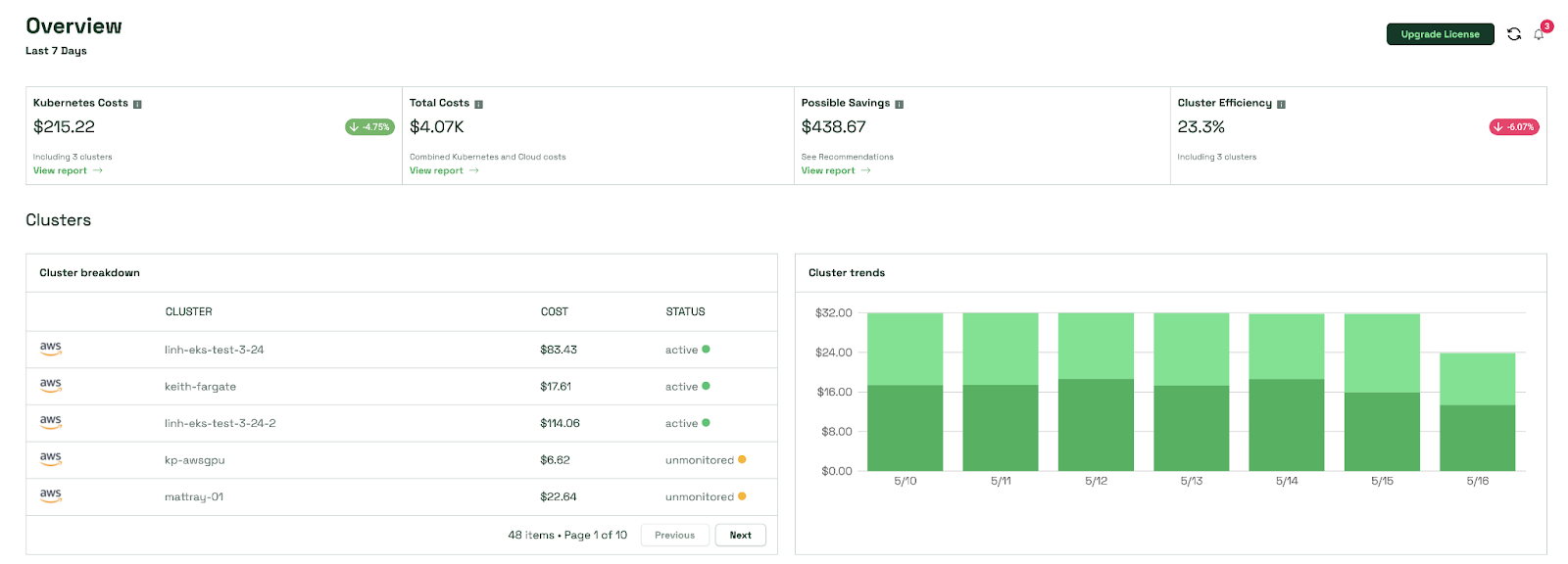
Kubecost is a Kubernetes cost monitoring and optimization tool that provides visibility into cluster spending and resource usage. It helps teams understand where costs originate across workloads, namespaces, and teams, and links this data back to cloud billing. The platform focuses on real-time insights, cost allocation, and optimization to reduce inefficiencies in Kubernetes environments.
Key features include:
- Real-time cost visibility: Tracks Kubernetes costs across clusters, namespaces, workloads, and teams, with breakdowns aligned to cloud billing data.
- Cost allocation and attribution: Maps spending to teams, products, and workloads, enabling chargeback and showback models.
- Multi-environment support: Aggregates cost data across multi-cloud, hybrid, and on-prem Kubernetes deployments into a unified view.
- Optimization insights: Identifies overprovisioned resources and surfaces opportunities to reduce waste based on actual usage data.
- Automated cost controls: Supports actions such as rightsizing workloads and scheduling resource usage to reduce unnecessary spend.
Governance and monitoring: Provides budgeting, forecasting, anomaly detection, and alerts to maintain cost control and predictability.
Source: KubeCost
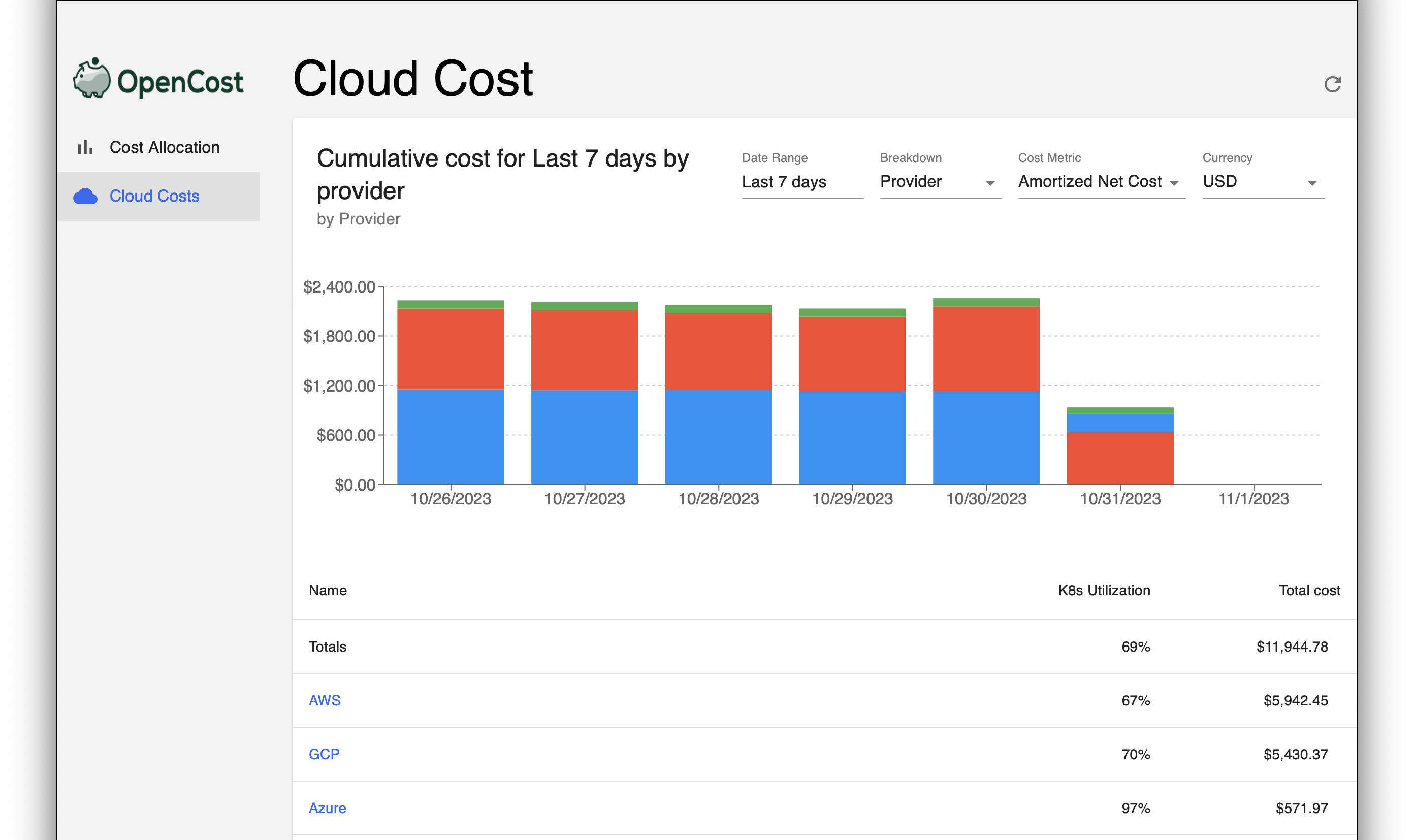
OpenCost

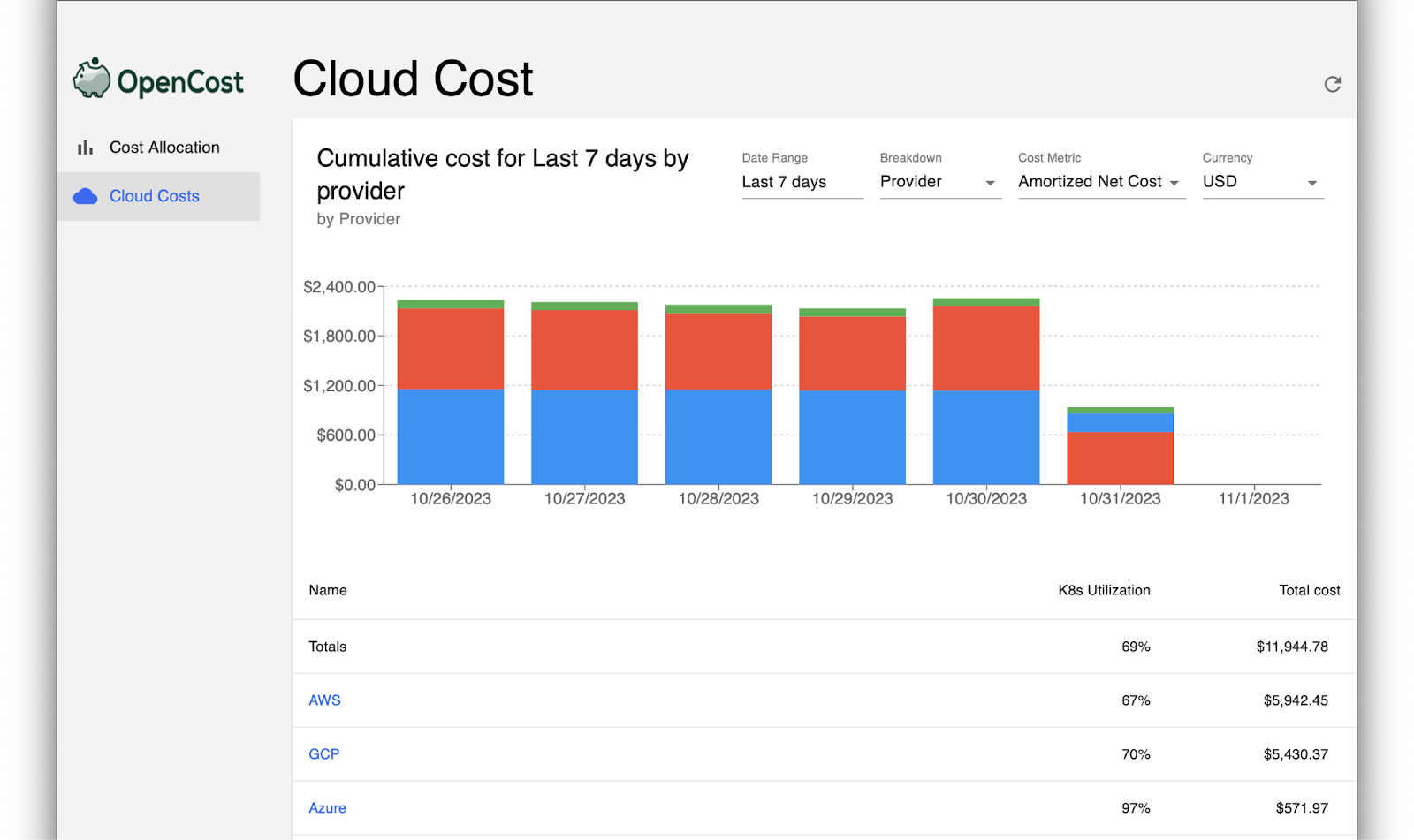
OpenCost is an open-source cost monitoring tool for Kubernetes and cloud environments. It provides a standardized way to measure, allocate, and analyze infrastructure costs across clusters and cloud providers. Built with transparency in mind, it allows teams to access cost data and integrate it into existing observability and monitoring systems.
Key features include:
- Real-time and historical cost allocation: Tracks costs by cluster, node, namespace, pod, and other Kubernetes resources over time.
- Multi-cloud cost monitoring: Supports cost visibility across AWS, Azure, and GCP environments.
- Dynamic pricing integration: Pulls pricing data from cloud billing APIs to reflect accurate, up-to-date infrastructure costs.
- Resource-level cost tracking: Allocates costs for CPU, GPU, memory, storage, and other in-cluster resources.
- Prometheus integration: Exposes cost and usage metrics through Prometheus endpoints for monitoring and analysis.
- Support for external and custom costs: Includes external services and on-prem environments using plugins or custom pricing inputs.
Open-source model: Freely available under an open-source license, allowing customization and community-driven development.
Source: OpenCost
nOps
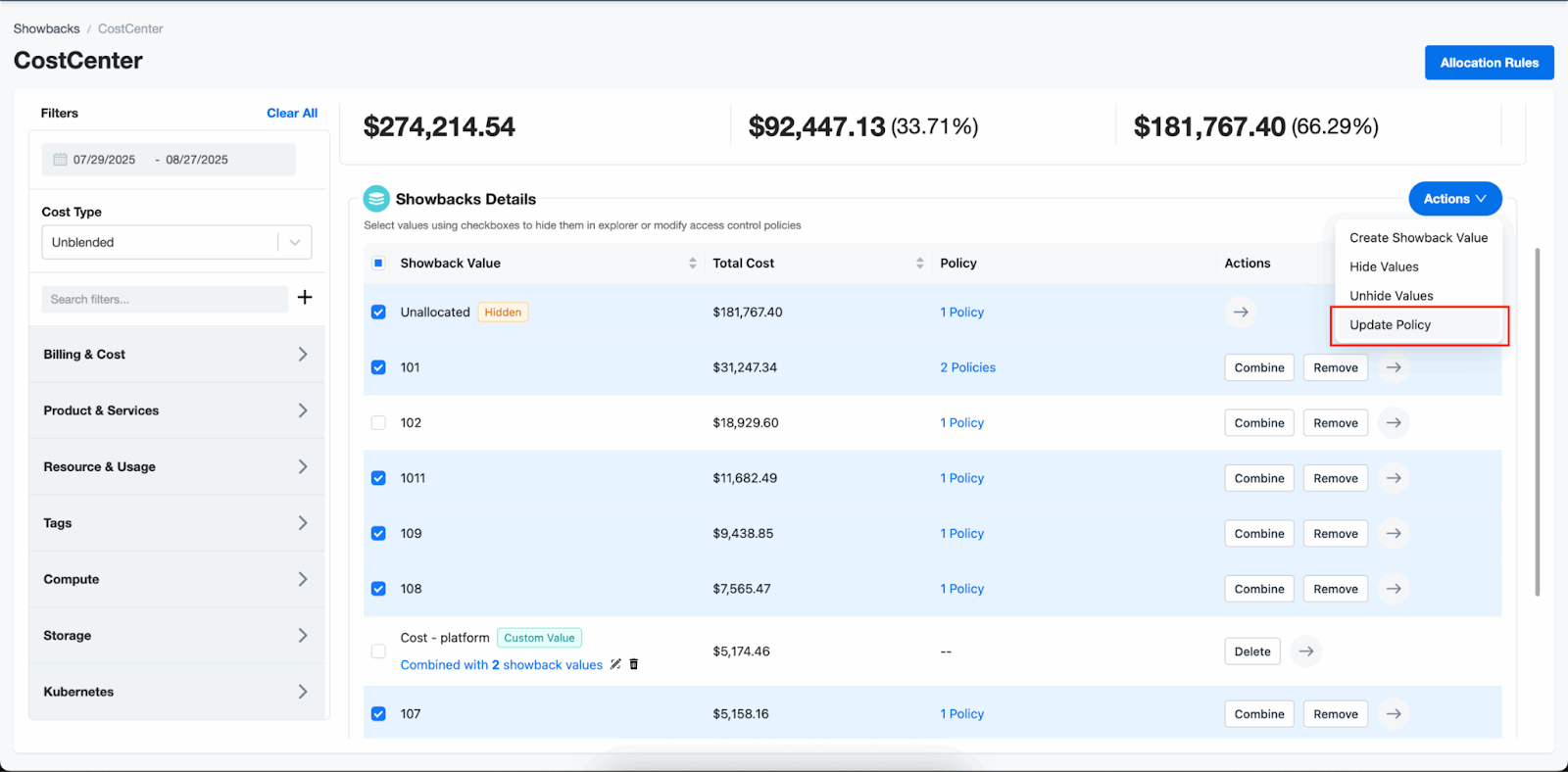
nOps is a cloud cost optimization platform focused on automating infrastructure efficiency, particularly for AWS and Kubernetes environments. It combines monitoring, analytics, and automation to continuously optimize compute, storage, and container workloads. The platform emphasizes real-time adjustments and integration with existing autoscaling tools.
Key features include:
- Automated commitment management: Optimizes savings plans and reserved instances using historical usage data and continuous rebalancing.
- Kubernetes (EKS) optimization: Provides container and node-level rightsizing, workload rebalancing, and efficiency improvements without replacing existing autoscalers.
- Real-time optimization engine: Continuously monitors usage and adjusts compute resources dynamically based on demand.
- Storage optimization: Identifies unused volumes, enables cleanup, and recommends cost-efficient storage configurations.
- Resource scheduling: Uses historical utilization data to schedule start and stop times for non-critical resources.
Cluster visibility and benchmarking: Offers detailed insights into cost, performance, and potential savings at cluster and node levels.
Source: nOps
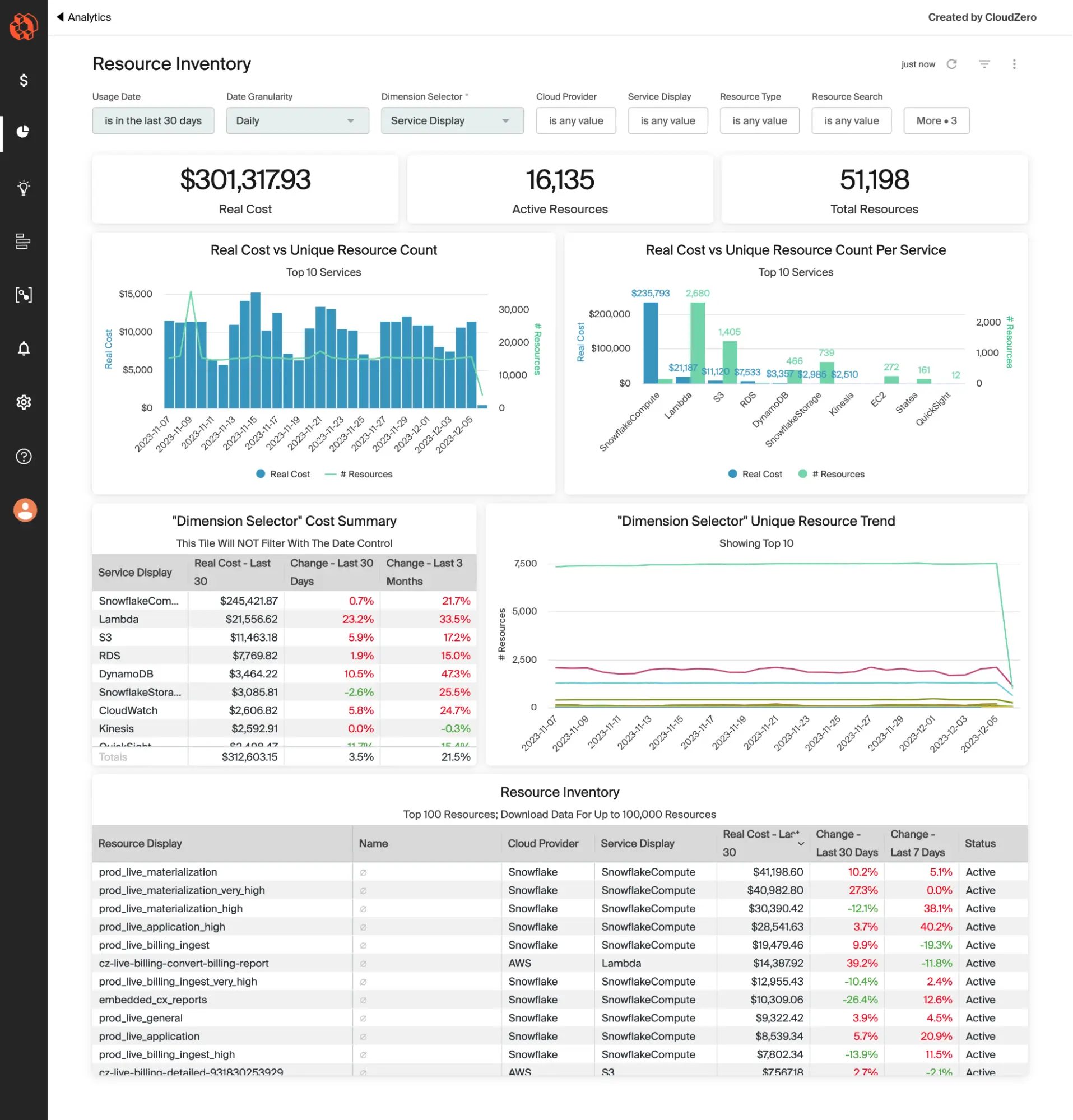
CloudZero
CloudZero is a cloud cost intelligence platform that connects infrastructure spending with business outcomes. Instead of only reporting costs, it focuses on explaining why costs occur and how they relate to products, customers, or features. This approach helps teams understand the financial impact of engineering decisions and optimize cloud usage accordingly.
Key features include:
- Cost-to-business mapping: Links cloud and AI spending to units such as customers, products, or features to provide business context.
- Granular cost allocation: Allocates shared and variable costs across teams and services, even when tagging is incomplete.
- Unit economics analysis: Enables calculation of metrics like cost per customer or cost per feature for better decision-making.
- Anomaly detection and insights: Identifies unexpected changes in spending and ties them to underlying usage patterns.
- Multi-source integration: Ingests data from multiple cloud, data, and AI providers for unified cost analysis.
- Embedded cost intelligence: Surfaces cost insights within engineering workflows, enabling teams to evaluate cost impact during development.
Criteria for Evaluating Kubernetes Cost Management Solutions
Granularity of Cost Attribution
The ability to attribute costs at a granular level enhances transparency and accountability within an organization. A Kubernetes cost management solution should map costs not only to clusters but to namespaces, labels, workloads, and potentially even down to individual deployments or business units. This visibility is critical for assigning ownership, understanding drivers of spend, and enabling effective chargeback or showback practices.
Granular cost attribution also supports more targeted optimization efforts. When teams can see exactly which applications or services are responsible for resource consumption, they can make better decisions for workload placement, sizing, and scaling.
Multi-Cluster and Multi-Cloud Support
Enterprises often operate multiple Kubernetes clusters across different cloud providers and geographic regions, making multi-cluster and multi-cloud support essential for accurate cost management. A solution should aggregate and normalize cost data from all clusters, regardless of where they are deployed, to present a unified view of organizational spend. This centralization is key for organizations pursuing hybrid or multi-cloud strategies or subject to regulatory constraints.
Multi-cloud support also streamlines governance and simplifies compliance with internal or external policies. By unifying billing, tagging, and reporting across providers like AWS, Azure, and Google Cloud, organizations can avoid fragmented insights and ensure consistent optimization practices.
Integration With Existing Monitoring/Observability Stack
Integration with your existing monitoring and observability stack, such as Prometheus, Grafana, or other APM tools, is crucial for getting maximum value from Kubernetes cost management. When cost metrics are accessible alongside performance and reliability data, engineers can correlate spend with system behavior and make data-driven decisions that balance cost and operational health. This reduces context-switching and helps teams get a holistic view of application efficiency.
Integration also enables more effective alerting, automation, and reporting workflows. By embedding cost insights directly into familiar dashboards and pipelines, organizations can enforce optimization efforts without disrupting engineering processes. Vendor support for common monitoring APIs and plugins simplifies adoption and accelerates time-to-value for Kubernetes cost management initiatives.
Learn more in our detailed guide to Kubernetes cost monitoring
Governance, Reporting and FinOps Support
Strong governance and flexible reporting features are necessary to distribute accountability and maintain financial discipline in dynamic Kubernetes environments. Solutions should offer customizable dashboards, budget alerts, role-based access controls, and detailed chargeback or showback capabilities. These tools enable stakeholders across engineering, finance, and leadership to track progress and make informed spending decisions.
FinOps support (formal processes that bridge engineering and finance) helps organizations operationalize cost optimization. A modern Kubernetes cost management tool should empower FinOps teams with automation, allocation policies, and collaboration features to continuously improve resource efficiencies. Reporting fosters transparency, supports audits, and simplifies regulatory compliance for organizations under strict financial controls.
Ease of Deployment and Maintenance
For many organizations, the operational overhead of deploying and maintaining a new cost management tool is a significant consideration. Solutions should support straightforward installation, automated updates, and minimal resource footprint within clusters. Tools that are compatible with standard Kubernetes package managers (like Helm) or offer SaaS options further reduce friction during onboarding.
Ongoing maintenance, including scaling with cluster growth, handling version upgrades, and troubleshooting, is equally important. The best solutions provide comprehensive documentation, strong community or vendor support, and automated diagnostics to reduce manual intervention.
Conclusion
Kubernetes cost management is no longer optional, it’s essential for maintaining financial control and operational efficiency in cloud-native environments. As Kubernetes usage scales, so does the complexity of cost visibility and optimization. The solutions covered here offer varying approaches to allocation, rightsizing, reporting, and integration, making it critical to match the tool to your team’s architecture and FinOps maturity.





One platform. Every team. Complete control.
Built for the complexity, speed, and ownership demands of modern cloud and AI environments