













 Written By
Asaf Liveanu

The problem with Kubernetes cost management isn't finding a tool — there are plenty. The real problem is that most Kubernetes cost visibility stops at the cluster boundary. Your cloud bill doesn't.
Networking, databases, managed services, storage — they're all real costs tied to your workloads, and almost none of them show up cleanly in the cost model your team built around namespaces and labels. Add multi-cluster deployments, shared infrastructure, inconsistent tagging, and GPU workloads, and the gap between what your Kubernetes cost tool shows and what actually appears on the invoice grows fast.
For FinOps teams managing mature cloud environments, that gap is where accountability breaks down. Month-end becomes a reconciliation exercise. Chargeback models break. Teams argue about numbers instead of acting on them.
The best Kubernetes cost management services in 2026 close that gap — connecting in-cluster metrics to actual cloud billing data and enabling real cost ownership at the team, product, or service level. Here's how the top five stack up.
What Kubernetes Cost Management Services Actually Do
Cloud providers bill at the VM or node level. Kubernetes users care about costs at the pod, namespace, or workload level. Cost management services bridge that gap by collecting metrics from cluster components and correlating resource consumption back to individual workloads, teams, or environments.
At a minimum, any Kubernetes cost management service needs to handle four things:
- Cost allocation: Map raw cloud invoices and usage metrics to specific pods, namespaces, labels, or teams — with enough granularity to support real chargeback or showback models, not just ballpark estimates.
- Waste identification: Continuously surface over-provisioned containers, idle nodes, orphaned volumes, and resources that generate cost without generating value.
- Optimization recommendations: Deliver actionable guidance on rightsizing pods, adjusting resource requests and limits, and improving node utilization — based on actual workload behavior, not static rules.
- Unified visibility: Consolidate in-cluster costs with out-of-cluster spend (networking, storage, managed services) across cloud providers in one view — so the number you see matches the number on the invoice.
Where tools diverge is depth. How granular is the attribution? How accurately does it reconcile with actual billing data? Can it support the shared cost models and custom ownership logic that mature FinOps teams actually need? That's where the real differences show up.
Related content:
-
Read our guide to Kubernetes Cost Optimization
-
Read our guide to Kubernetes Pricing
- Read our guide to What Is Kubernetes
The Top 5 Kubernetes Cost Management Services in 2026
1. Finout

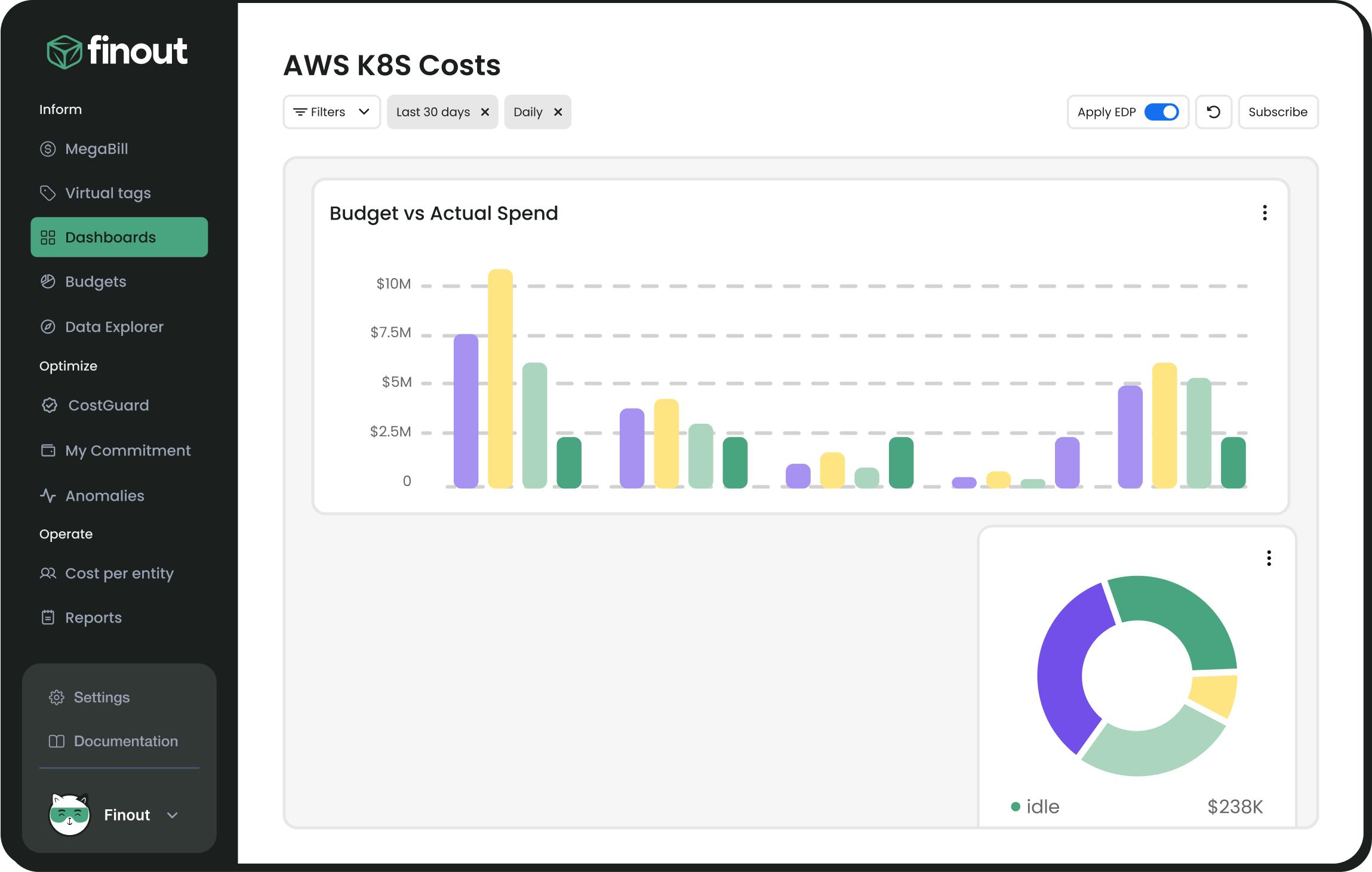
Finout is a unified FinOps platform built for teams that have outgrown basic Kubernetes cost dashboards. Where most tools stop at namespace-level visibility, Finout connects Kubernetes spend to your full cloud bill through MegaBill — a single, unified cost view that spans cloud providers, Kubernetes clusters, SaaS tools, and data infrastructure. You see one number that actually matches the invoice.
The core advantage for mature FinOps teams is Virtual Tags: a tagless allocation engine that lets you remap cost ownership without waiting on engineering to re-tag resources. Define allocation logic once — by team, product, environment, or any custom business dimension — and Finout applies it across your entire cost dataset in hours, not quarters. That includes shared Kubernetes infrastructure that would otherwise require complex manual splits or approximations.
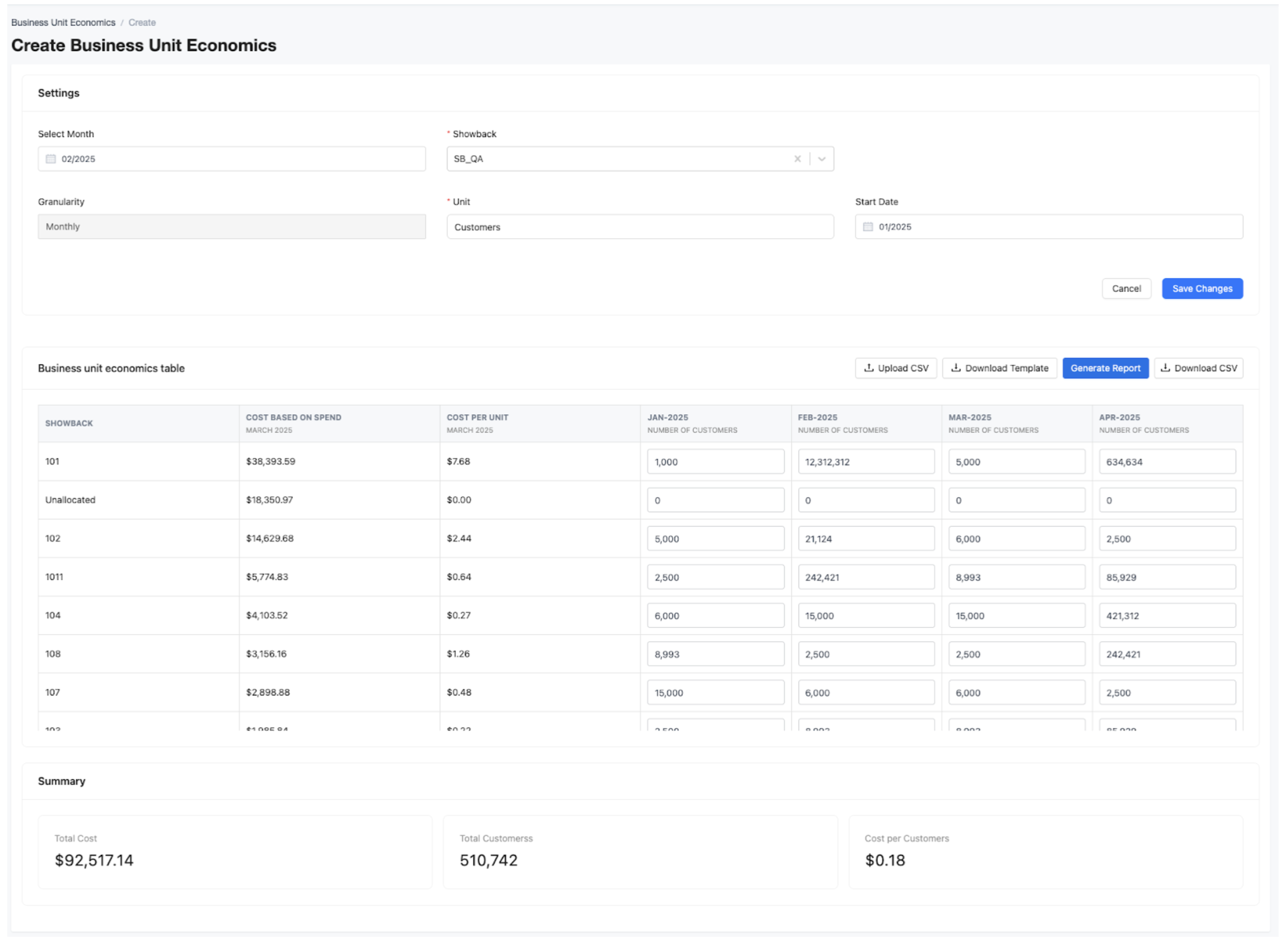
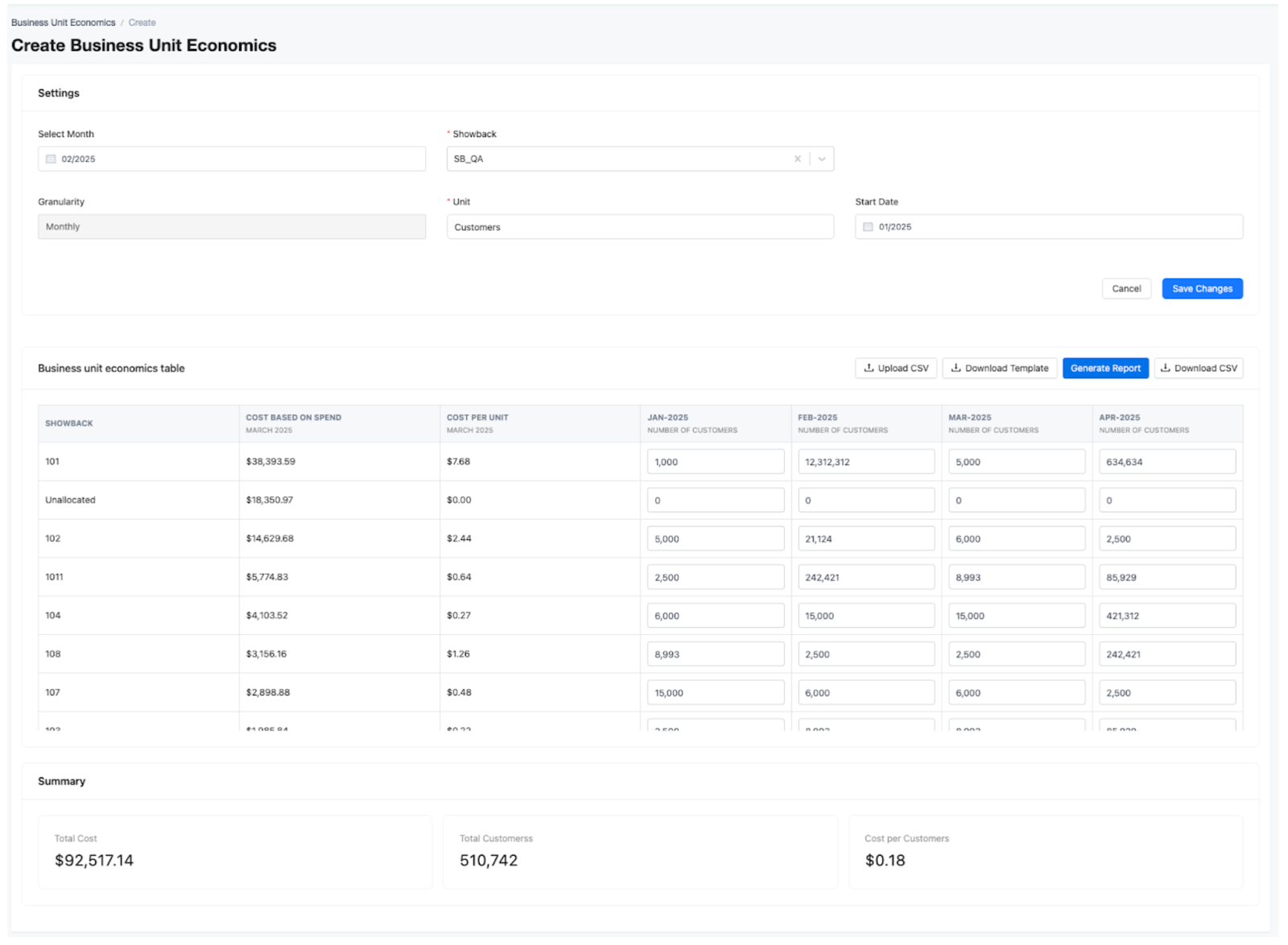
CostGuard handles waste detection and rightsizing recommendations, surfacing idle resources and over-provisioned workloads with direct references to affected infrastructure. For organizations building unit economics into their FinOps practice — cost per customer, per feature, or per transaction — Finout supports custom cost metrics that pull from both Kubernetes and out-of-cluster spend, giving you models that hold up to exec scrutiny.
Key capabilities:
- MegaBill: unified view of Kubernetes, cloud, and SaaS spend in a single dashboard that reconciles with actual invoices
- Virtual Tags: tagless cost allocation that remaps ownership without re-tagging infrastructure
- CostGuard: automated waste detection and rightsizing recommendations
- Unit economics: custom cost metrics mapped to business dimensions across all spend sources
- Agentless integration with existing monitoring stacks (Prometheus, Datadog, Grafana)
- Self-service cost visibility for both engineering teams and finance stakeholders
Finout is the right choice for FinOps teams managing multiple clouds, complex shared infrastructure, or environments where cost ownership needs to evolve as fast as the organization ships.
2. Kubecost

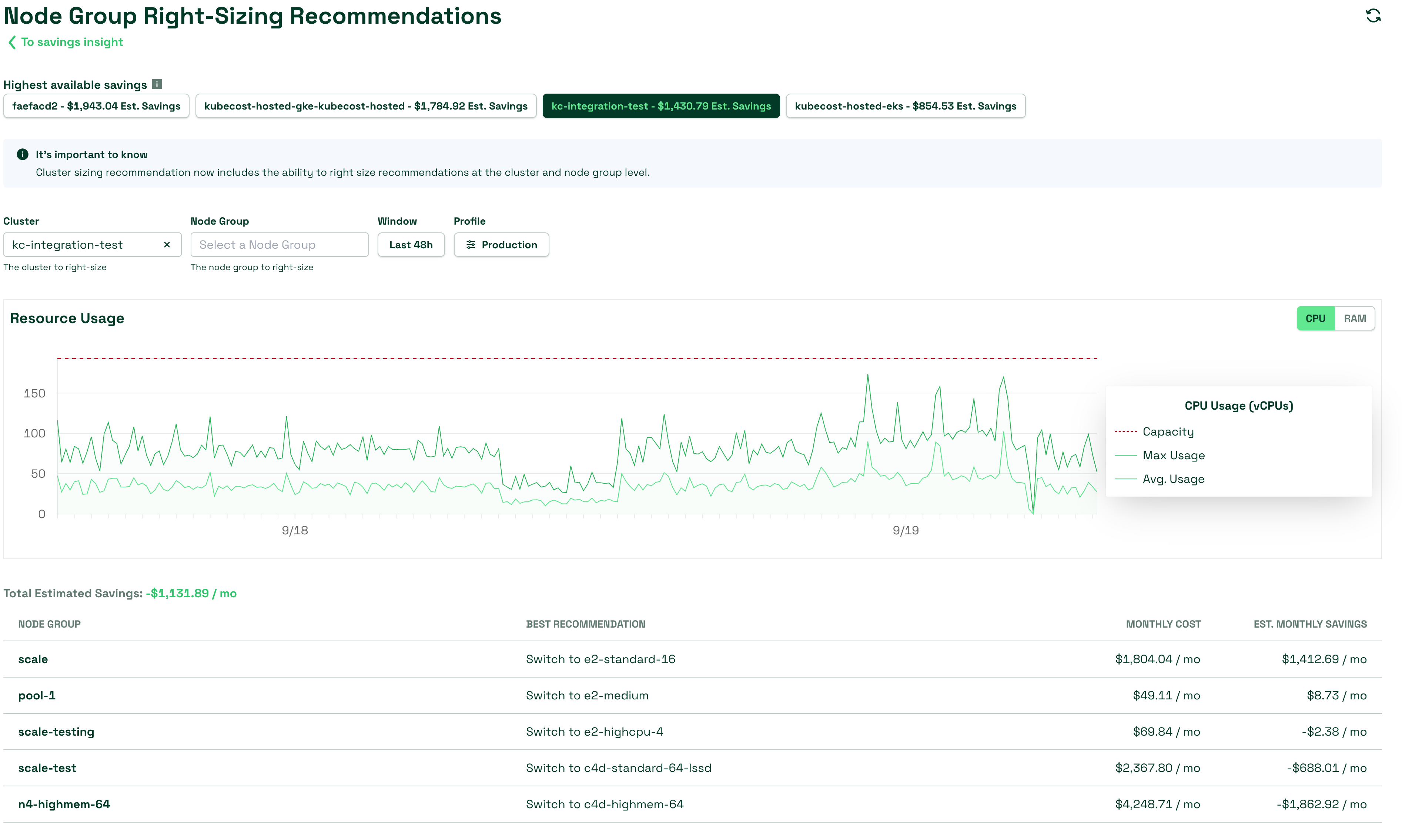
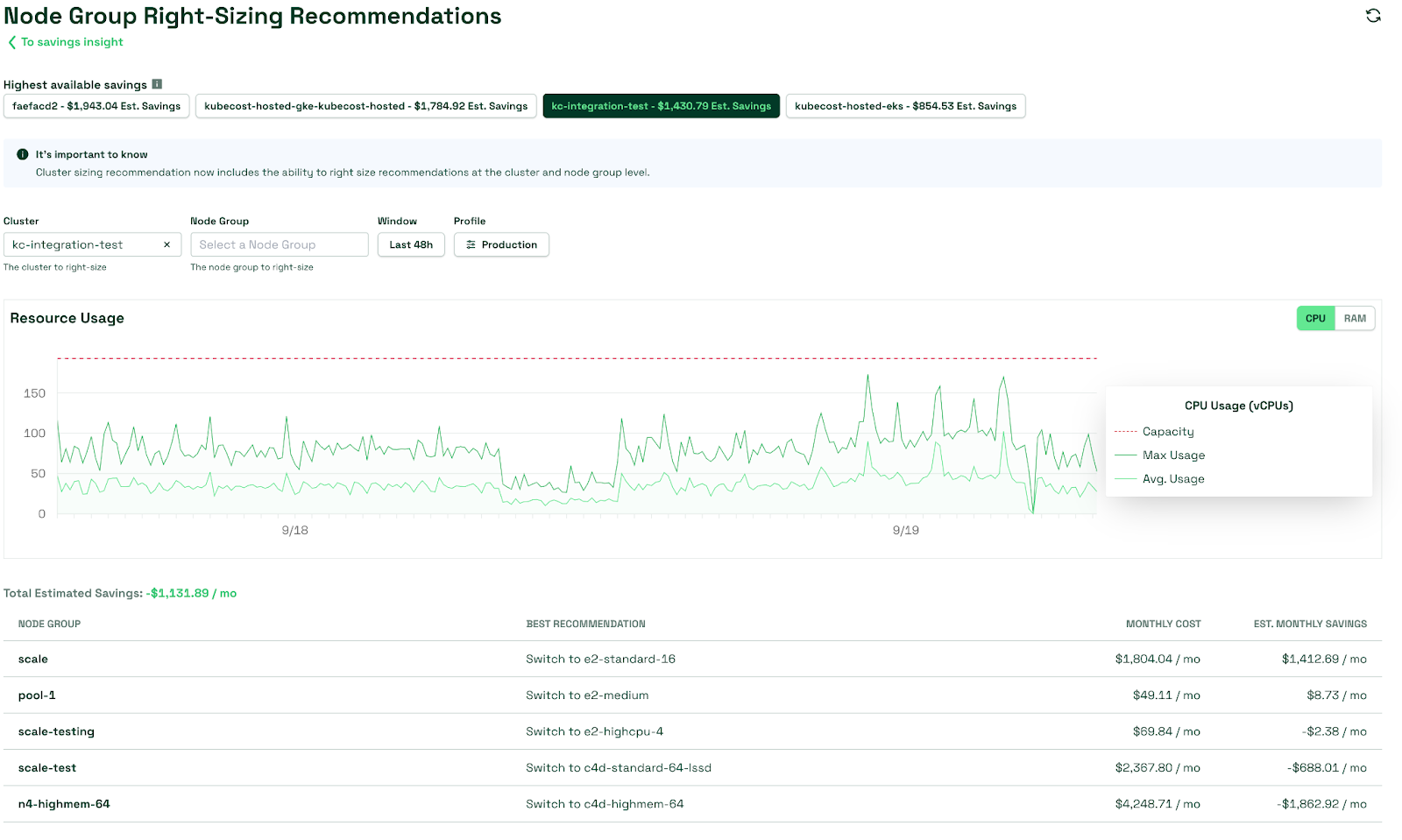
Kubecost is purpose-built for Kubernetes cost visibility. It connects usage metrics from cluster components to actual cloud provider billing data — enabling attribution down to the workload, namespace, or label level — and reconciles that data against real invoices rather than estimates. It handles both in-cluster and out-of-cluster spend and supports multi-cluster deployments.
For teams that want deep Kubernetes-native attribution and a solution that integrates closely with how Kubernetes itself tracks resource usage, Kubecost delivers strong granularity. Its budget governance and alerting layer is well-suited for teams that need to enforce spending controls at the team or project level in real time.
Key capabilities:
- Real-time cost monitoring at the namespace, workload, and label level
- Cloud bill reconciliation against actual provider invoices
- Rightsizing recommendations based on observed resource utilization
- Budget alerts, recurring reports, and configurable governance controls
- Multi-cluster and multi-cloud support
Source: KubeCost
3. Amnic

Amnic is a cloud cost observability platform focused on Kubernetes environments. Its strength is in cluster-level visibility — compute, memory, and storage utilization across nodes and workloads — with granular breakdowns by Node ID and built-in integration with Karpenter for node provisioning optimization.
It suits teams that want clear infrastructure-layer visibility and automated optimization guidance, particularly those running Karpenter for node lifecycle management. Reporting is accessible without requiring a dedicated FinOps function to interpret it.
Key capabilities:
- Cluster utilization metrics at the node and container level
- Granular cost breakdowns by Node ID across compute, storage, and network
- Container and PVC rightsizing recommendations
- Karpenter configuration insights for node provisioning optimization
- Visual reporting with tagging and metadata filtering
4. ScaleOps

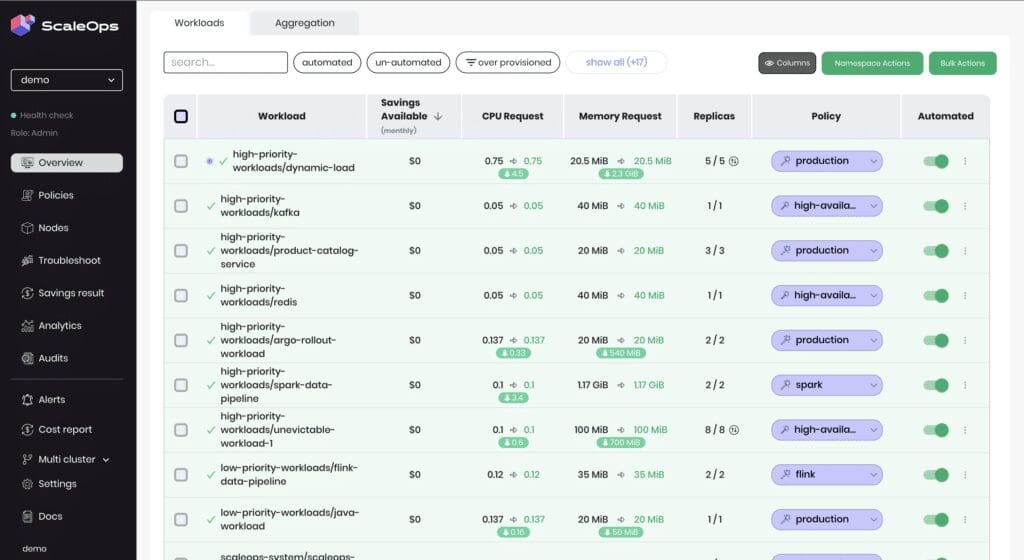
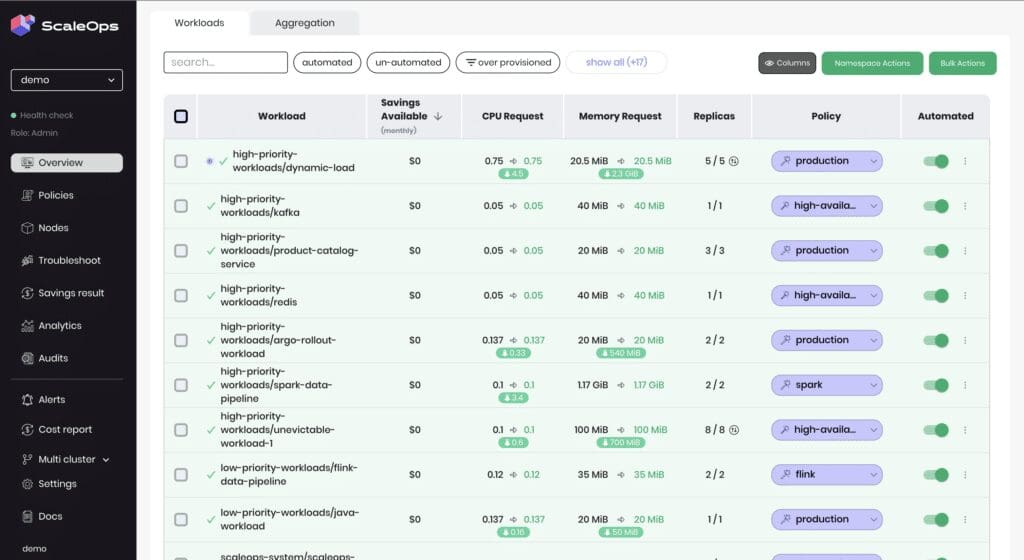
ScaleOps provides Kubernetes cost visibility with direct integration into cloud billing systems — AWS CUR, GCP Billing Export, and Azure Cost Management — so cost data reflects actual invoice-level figures, including discounts and enterprise agreement pricing. That connection to real billing data rather than usage estimates is its core strength.
It supports cost attribution by namespace, label, application, or annotation, with customizable reporting and period-over-period comparison dashboards. Multi-cluster consolidation and GPU/network cost tracking make it a solid option for teams with complex infrastructure that need precise attribution at scale.
Key capabilities:
- Cloud billing integration with AWS, GCP, and Azure at the invoice level (including discounts and EAs)
- Cost attribution by namespace, label, application, or annotation
- Multi-cluster cost consolidation into a single view
- Period-over-period cost comparison dashboards
- GPU and network cost tracking by workload
Source: ScaleOps
5. nOps

nOps is an AWS optimization platform with dedicated EKS cost management capabilities. It continuously monitors cluster usage and applies real-time recommendations using live data, with native support for both Karpenter and Cluster Autoscaler. Its AI-driven commitment management engine handles Reserved Instance and Savings Plan optimization with a 100% utilization guarantee — automatically provisioning compute at the best available price across spot, on-demand, and reserved options.
nOps is best suited for AWS-heavy organizations running EKS at scale that want continuous automated optimization rather than manual review cycles. Storage optimization for EBS and native integrations with GitHub, GitLab, and Terraform round out a well-integrated AWS toolchain.
Key capabilities:
- EKS-native rightsizing for containers and nodes across spot, on-demand, and reserved compute
- Dynamic container rightsizing with one-click adjustments for deployments and daemonsets
- AI-driven Reserved Instance and Savings Plan management with utilization guarantee
- Hourly visibility into container and node efficiency, cluster cost, and potential savings
- EBS storage optimization with GitHub, GitLab, and Terraform integrations
Source: nOps
How to Choose the Right Kubernetes Cost Management Service
The right choice depends on where your FinOps practice is today and what you're actually trying to solve. A few questions that should drive the decision:
Do you need Kubernetes-only visibility, or full cloud cost management? If you're managing costs across multiple cloud providers, SaaS tools, and Kubernetes clusters, a Kubernetes-native tool solves only part of the problem. You'll still need to stitch together the full picture manually at month-end. A platform that unifies Kubernetes and out-of-cluster spend from the start avoids that reconciliation overhead entirely — and gives finance and engineering a single number they can both trust.
Is your tagging clean enough to support real allocation? Most cost allocation models depend on tags. Most Kubernetes environments have inconsistent or incomplete tagging. If your engineering team doesn't have bandwidth to enforce tagging policies at the infrastructure level, look for a tool that can allocate costs without requiring re-tagging — applying ownership logic at the reporting layer instead.
Do you need chargeback, or just showback? Showback gives teams visibility without billing consequences. It's a reasonable starting point, but mature FinOps operating models require real chargeback — costs that flow to actual team or product budgets. That demands deeper attribution, consistent definitions across engineering and finance, and allocation logic that can be governed and audited. Not every tool here supports that level of rigor out of the box.
What's your primary cloud? nOps is purpose-built for AWS and performs well in EKS-heavy environments. If you're multi-cloud or running on GCP and Azure alongside AWS, you'll need a platform with broad cloud provider support and billing reconciliation across all three.
Will this be used outside the FinOps team? The best FinOps programs extend cost ownership to engineering teams and finance stakeholders — not just the FinOps function. If accountability is the goal, prioritize tools with self-service reporting that infrastructure leads and FP&A can use without requesting custom exports. Adoption is what drives accountability. A tool that only the FinOps team uses is a reporting tool, not a FinOps system.
Conclusion
Kubernetes cost management is foundational to any serious FinOps practice. Clusters scale fast, workloads change constantly, and the gap between what teams think they're spending and what hits the invoice compounds quickly without proper visibility and allocation in place.
All five services reviewed here are capable tools. The difference comes down to depth: how granular the attribution goes, how accurately it reconciles with actual billing data, and whether it can support the allocation models your organization needs to run real accountability across teams.
If you're running a mature FinOps operation — one that needs to connect Kubernetes costs to the full cloud bill, with allocation that adapts as fast as your org and unit economics that stand up to exec scrutiny — that's exactly what Finout is built for.

.svg)