













Spinning up new cloud infrastructure and virtual machines to meet fluctuations in demand has always been challenging. But if you’re not keeping a close eye on your cloud spend, you can quickly end up way over budget. Azure billing is no exception.
It’s important to stress the point that cloud cost management isn’t all about reducing costs, but about optimizing your spend by getting a clear picture of your unit economics. By using modern cloud cost observability tools, you can garner a clearer understanding of what you’re spending and how much each end user – be they internal teams or employees – costs your company. This is especially important for SaaS businesses, for whom cloud computing is one of the main cost centers.
In this blog post, we’ll explore the various challenges and solutions involved in monitoring and optimizing cloud costs for the Microsoft Azure platform.
Editor’s note: Article has been updated to cover recent market trends and current features and capabilities of Azure cost management tools as of 2026.
This is part of an extensive series of guides about DevOps.
Related content:
-
Read our guide to Azure Cost Monitoring
Azure Cost Management Tools Market Trends
Market Size and Growth
According to recent market research, the Azure cost management tool market is expanding quickly as more organizations move workloads to the cloud. The market is valued at around $5 billion and is expected to grow to $11.56 billion by 2031 at a 15% compound annual growth rate (CAGR).
This growth reflects the increasing difficulty of managing cloud spending. As organizations scale their Azure environments, they need tools that provide clear visibility into resource usage and cost allocation. The shift toward operational expenditure (OpEx) models also pushes companies to monitor spending more closely and optimize cloud budgets.
Key Drivers of Market Growth
Several factors are accelerating adoption of Azure cost management tools. One major driver is the complexity of cloud billing, especially in hybrid and multi-cloud environments where costs come from many services and providers.
The rise of serverless computing and containerized workloads also contributes to this demand. These architectures scale dynamically, which makes manual cost tracking difficult. As a result, organizations rely on specialized tools that provide detailed cost breakdowns, anomaly detection, and automated optimization.
Another important factor is the growing adoption of FinOps practices. Both small and large organizations are implementing financial management processes to better control cloud spending and improve return on investment.
Technology And Innovation Trends
Innovation in the market is increasingly driven by AI and machine learning capabilities. Modern tools use these technologies to deliver predictive analytics, identify cost anomalies, and automate optimization tasks.
Another major trend is the integration of advanced analytics and automation. These features help organizations move from reactive cost reduction to proactive cost management by forecasting future spending and recommending optimization strategies.
Sustainability is also becoming a consideration. Some tools now help organizations track energy usage and reduce the carbon footprint of their cloud workloads.
Challenges of Azure Cost Management
As a pay-per-use service that bills by the second, Azure offers total flexibility. However, that also means keeping control over costs can be challenging, particularly during periods of high or unexpected demand. While auto-scaling makes it easy to meet your computing demands, it also means an increased risk of cloud bill shock.
Like other cloud services, including Google Cloud Platform (GCP) and Amazon Web Services (AWS), Azure cost optimization requires a clear understanding of the relationships between usage, services, and costs. Overprovisioning, for example, is a common problem that requires establishing an optimal balance between service availability, compute requirements, and the various costs they incur.
- Cross-platform observability: Multi-cloud is now the standard approach, with 58% of businesses now using a combination of AWS, Azure, and GCP resources. However, most cloud cost observability tools only support one platform. This makes tooling more complicated and, as a consequence, it becomes harder to consistently manage costs across the board.
- Lack of app-specific visibility: While all the major cloud vendors provide native cost-observability tools, their ability to match cost allocations to specific projects, end users, or applications tends to be very limited. Usually, individual resources need to be tagged manually to gain a clear picture of your unit's economics. This is a time-consuming and complicated process that often requires DevOps expertise.
- Inaccurate budget forecasting: The more cloud resources you have, the harder it is to accurately track and forecast usage and budget, especially if these resources span multiple vendors and third parties. This makes it difficult to avoid under-provisioning or overprovisioning which, in turn, can cause service disruptions or have you paying for resources you’re not using.
Key Features, Functions, and Tradeoffs to Look Out for When Managing Azure Spend
Cloud cost optimization tools serve to reduce cloud waste and optimize resources while still delivering an uninterrupted end-user experience. The most sophisticated solutions align with the principles of the FinOps model by facilitating collaboration between teams, ensuring every team has ownership of their cloud usage, and providing timely access to reports. To that end, here are some key considerations to look out for when choosing an Azure cost management tool:
- Visibility and usage context: As with other cloud vendors, the tools Azure provides don’t give you granular visibility over your unit economics. As such, while you can get a clear picture of your usage, it’s hard to tie that usage to specific end users, apps, or product features.
- Budgeting and forecasting: Operational expenses are relatively easy to control and forecast, which makes it hard to establish appropriate budgets. However, using a tool that leverages machine learning and artificial intelligence can empower accurate forecasting based on historical and real-time data.
- Azure platform integration: The need for out-of-the-box Azure integration might be obvious, but it’s worth noting simply because few FinOps platforms support all cloud platforms and services. Whether you use Azure to support some or all of your cloud infrastructure, you’ll need a tool that can read Azure Cost and Usage Reports (CURs).
- Free trial or demo version: While native cloud cost management solutions provided by the platform vendors themselves are usually free, a full-fledged FinOps solution will typically cost a monthly fee. As such, you’ll likely want the opportunity to give it a test run in your environment before committing to a monthly or yearly subscription.
- A cost comparison tool: Some cloud cost observability tools include cost comparison features that let you explore potential costs when using alternative services. This allows multi-cloud companies to fine-tune their resource allocation by choosing the most suitable vendor for a given workload.
Of course, the above list is by no means exhaustive, but by using these selection criteria as guidelines, you can make an informed decision when choosing from the options below (among others).
Top Azure Cloud Cost Management Tools
With cloud environments becoming increasingly complex and difficult to manage, the demand for more sophisticated cost-management and observability tools is soaring. Choosing the right tool will help you make sense of where your cloud budget is going and help drive a culture of continuous improvement and optimization.
Here are some of the most popular cost-management tools for Azure deployments:
Dedicated Cloud Cost Management and FinOps Platforms
#1. Finout
Finout is a pioneer of the burgeoning FinOps movement. Finout's holistic FinOps platform is built from the ground up to cover all core principles and capabilities of the FinOps framework, as defined by the FinOps Foundation.
Finout is a cloud cost management tool for all cloud providers and services, including full native support for the Azure platform. Finout seamlessly integrates with your Azure CURs and other APIs to provide complete visibility and control over your Azure deployments, including virtual machines, containers, storage resources, and more.
Finout goes much further than basic cloud cost-management tools to provide granular insight into the Azure unit economics that matter to you, such as the cost per app, feature, customer, project, or team. Finout also integrates with Kubernetes, Snowflake, Databricks, Datadog, and more!
Year founded: 2021, Tel Aviv, Israel
G2 score: 4.6
Best for: SaaS companies with multi-cloud environments using a combination of resources provided by some or all of the major cloud vendors.
Pricing structure: Flat monthly rate starting at $500 per month. Learn more here.
#2. Microsoft Cost Management
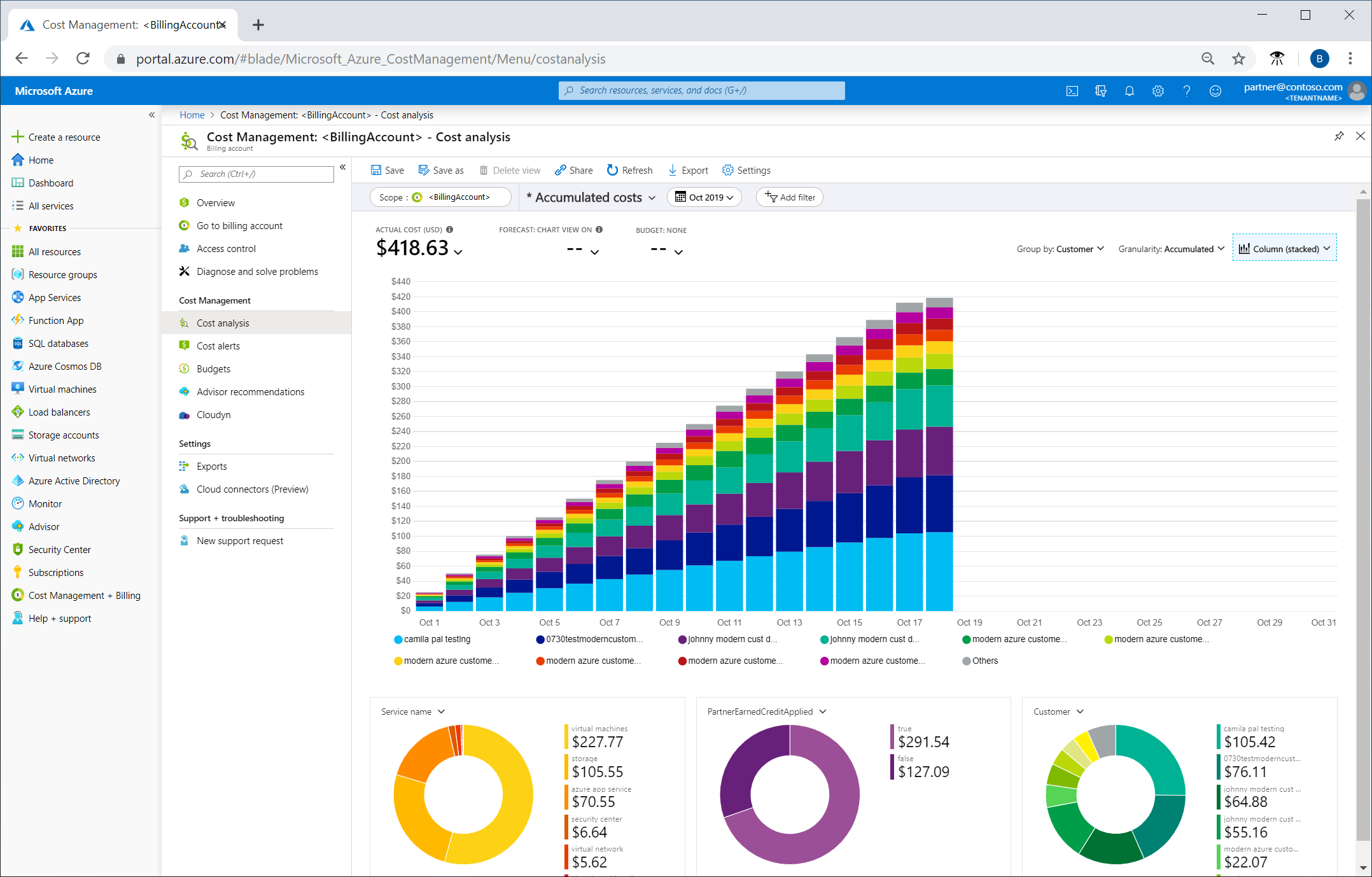
Microsoft Cost Management provides capabilities to track and control cloud spending across Azure environments. It allows teams to monitor usage, analyze expenses, detect anomalies, and forecast future costs. Users can break down costs by resource groups, services, locations, or custom tags, which helps identify where money is being spent and which areas need optimization.
The platform also includes budgeting and alerting features to enforce spending limits and notify teams of unusual activity, such as spikes or drops in usage. Cost allocation tools make it possible to distribute expenses across teams, projects, or business units. In addition, reporting and export capabilities allow organizations to integrate cost data with external systems for deeper analysis.
Year founded: 2010, Redmond, Washington (Microsoft Azure)
G2 score: 4.2
Best for: Microsoft’s native cost management tools are ideal for businesses that exclusively use Azure Cloud, but it provides limited coverage of other platforms and services.
Pricing structure: Microsoft Cost Management is free for Azure users. However, there’s an option to connect to AWS as well, which is charged at 1% of your total AWS-managed spend.
#3. CloudCheckr
CloudCheckr focuses on helping organizations gain visibility into their cloud usage and spending across AWS and Azure. It provides insights into current and historical costs, including which resources are being used, by whom, and how they contribute to overall consumption. This level of transparency enables teams to make informed decisions based on accurate and complete data.
The platform emphasizes automation and optimization by identifying waste and recommending actions such as rightsizing resources or leveraging commitment-based discounts. It also includes governance, security, and compliance checks, along with customizable reporting and billing features.
Year founded: 2011, Rochester, New York
G2 score: 4.4
Best for: Enterprises and managed service providers seeking robust cost management combined with security and compliance features.
Pricing structure: CloudCheckr offers subscription-based pricing tailored to customer needs, with a free trial available.
#4. Flexera One
Flexera One is a SaaS platform that provides unified visibility and control across hybrid IT environments, including cloud, SaaS, and on-premises infrastructure. It combines FinOps and IT asset management capabilities to help organizations track usage, costs, and risk across their entire technology stack. This centralized approach allows teams to optimize spending while maintaining compliance and improving security.
The platform uses data and analytics from its Technology Intelligence Platform to deliver insights into asset usage, lifecycle status, and cost drivers. It helps identify redundancies, reduce technical debt, and uncover opportunities for cost savings. Flexera One also enables organizations to align IT spending with business value by mapping costs to services, departments, and users.
Year founded: 1987, Itasca, Illinois
G2 score: 4.3
Best for: Large enterprises with complex multi-cloud environments looking for comprehensive cost management and governance.
Pricing structure: Flexera One offers custom pricing based on the scope of deployment, with a free trial available.
#4. Flexera One
Flexera One is a SaaS platform that provides unified visibility and control across hybrid IT environments, including cloud, SaaS, and on-premises infrastructure. It combines FinOps and IT asset management capabilities to help organizations track usage, costs, and risk across their entire technology stack. This centralized approach allows teams to optimize spending while maintaining compliance and improving security.
The platform uses data and analytics from its Technology Intelligence Platform to deliver insights into asset usage, lifecycle status, and cost drivers. It helps identify redundancies, reduce technical debt, and uncover opportunities for cost savings. Flexera One also enables organizations to align IT spending with business value by mapping costs to services, departments, and users.
Year founded: 1987, Itasca, Illinois
G2 score: 4.3
Best for: Large enterprises with complex multi-cloud environments looking for comprehensive cost management and governance.
Pricing structure: Flexera One offers custom pricing based on the scope of deployment, with a free trial available.
#5. Yotascale
Yotascale provides visibility into cloud costs across complex and large-scale environments. It allows teams to analyze spending at different levels, from high-level summaries down to individual engineers, projects, or services. This granular visibility helps organizations understand exactly where costs originate and who is responsible for them.
The platform also focuses on proactive cost control through anomaly detection and alerting. It identifies unusual spending patterns in real time and notifies the appropriate teams so they can take immediate action. In addition, Yotascale supports cost allocation, automated tagging, and predictive budgeting.
Year founded: 2015, Menlo Park, California
G2 score: 4.4
Best for: Enterprises with complex, large-scale cloud deployments looking for advanced cost optimization and anomaly detection.
Pricing structure: Yotascale offers custom pricing based on cloud usage, with a free trial available.
#6. Harness Cloud Cost Management
Harness Cloud Cost Management integrates cost visibility and optimization directly into engineering and DevOps workflows. It provides real-time insights into cloud spending across teams, services, and environments, with support for multi-cloud and Kubernetes cost tracking. Teams can use natural language queries to explore cost data and quickly identify major cost drivers or inefficiencies.
The platform emphasizes automation and AI-driven optimization. It detects idle or over-provisioned resources, generates right-sizing recommendations, and can automatically enforce cost-saving actions through governance policies. Features like anomaly detection, budgeting, and commitment management help teams continuously optimize cloud usage while maintaining control through policy-driven automation.
Year founded: 2016, San Francisco, California
G2 score: 4.6
Best for: DevOps teams looking to integrate cost management directly into their software delivery pipelines.
Pricing structure: Harness offers custom pricing based on usage, with a free tier available for smaller teams.
#7. Apptio Cloudability
Apptio Cloudability is a FinOps platform to help organizations manage and optimize cloud spending across multi-cloud and containerized environments. It provides detailed visibility into cloud usage and costs, enabling teams to detect waste, track performance, and allocate expenses accurately across business units and workloads.
The platform combines analytics, automation, and collaboration features to improve cloud financial management. It supports budgeting, forecasting, and unit economics analysis, helping organizations connect cloud spending to business outcomes. Cloudability also promotes cross-functional collaboration by giving finance, engineering, and operations teams a shared view of cloud costs.
Year founded: Acquired by Apptio in 2019
G2 score: 4.2
Best for: Cloudability is best suited to large SaaS vendors and managed services providers with dedicated IT operations departments.
Pricing structure: Cloudability is a subscription-based service that offers custom pricing, with rates starting at $499 per feature per month. There’s also a free 14-day trial available.
Automated Cost Optimization and Resource Efficiency Tools
#8. Azure Advisor
Azure Advisor is a built-in Azure service that provides personalized recommendations to help optimize cloud resources across cost, performance, reliability, security, and operational excellence. It analyzes resource configurations and usage patterns, then surfaces actionable insights that help teams reduce waste and improve efficiency. These recommendations can be scoped to specific subscriptions or resource groups.
The tool also provides step-by-step remediation guidance and supports automated alerting when new recommendations are available. Users can access Advisor through the Azure portal, CLI, or APIs, allowing integration into existing workflows. Its “cloud score” helps assess how well workloads align with best practices, giving teams a simple way to track improvements over time.
Year founded: 2010 (Microsoft Azure)
G2 score: 4.2
Best for: Organizations looking for a simple, integrated tool to optimize Azure costs without needing third-party solutions.
Pricing structure: Azure Advisor is free for Azure users.
#9. ProsperOps
ProsperOps is a FinOps automation platform to continuously optimize cloud costs across AWS, Azure, and Google Cloud. It focuses on managing commitment-based discounts and resource usage through automation, combining rate optimization and workload optimization into a single system. By adapting to changes in usage, it helps maximize savings while reducing the risks associated with long-term commitments.
The platform operates autonomously, taking frequent optimization actions to improve savings without manual intervention. It also provides centralized reporting and benchmarking through metrics like Effective Savings Rate, allowing teams to measure performance against industry standards. This approach reduces the operational burden on FinOps teams while delivering consistent, quantifiable cost optimization outcomes.
Year founded: 2018
Best for: FinOps and cloud engineering teams seeking hands-free, intelligent commitment management across Azure and other hyperscalers.
Pricing structure: Zero-risk model, ProsperOps charges a percentage of the savings it delivers. Learn more here.
#10. Spot by NetApp
Spot by NetApp focuses on optimizing cloud infrastructure costs by improving visibility, automation, and efficiency across workloads. It helps organizations monitor resource usage, reduce waste, and ensure that cloud spending aligns with business goals. By combining cost optimization with broader IT visibility, it enables teams to make informed decisions about their infrastructure and spending.
The platform leverages data and analytics to deliver actionable insights and automate optimization processes. It simplifies complex environments by providing a unified view of cloud resources and enabling continuous optimization across the technology stack. This helps organizations balance cost, performance, and risk while maximizing the value of their cloud investments.
Year founded: 2015, acquired by NetApp in 2020
G2 score: 4.7
Best for: Organizations looking for advanced automation and cost optimization, especially those with fluctuating workloads.
Pricing structure: Spot by NetApp offers custom pricing based on usage, with a free trial available.
#11. CAST AI
CAST AI is an automation platform for Kubernetes environments that continuously optimizes both cost and performance. It monitors real-time workload behavior, including metrics like latency, error rates, and resource utilization, and automatically adjusts infrastructure to match demand. This eliminates the need for manual tuning and reduces the operational burden on engineering teams.
The platform includes capabilities such as workload rightsizing, automated scaling, and intelligent workload placement. It adjusts CPU and memory allocation with high precision and dynamically scales infrastructure based on actual usage. By combining predictive models with real-time automation, CAST AI reduces over-provisioning and ensures efficient resource utilization.
Year founded: 2020, Miami, Florida
G2 score: 4.5
Best for: Organizations running Kubernetes on Azure looking for advanced cost optimization tools.
Pricing structure: CAST AI offers pay-as-you-go pricing, with a free tier available for basic monitoring.
#12. Turbonomic (IBM)
IBM Turbonomic provides AI-driven automation to continuously optimize cloud resources based on real-time application demand. It analyzes the relationship between applications and infrastructure, then generates actions that ensure performance while minimizing cost. These actions include optimizing virtual machines, databases, disks, and Kubernetes environments across Azure and other platforms.
The platform also manages reserved instance utilization and supports scenario planning through “what-if” modeling for cost and performance. Its automation capabilities allow for dynamic scaling and resource allocation, reducing both underutilization and overprovisioning.
Year founded: 2009, acquired by IBM in 2021
G2 score: 4.5
Best for: Enterprises seeking AI-driven automation for cost and performance optimization in multi-cloud environments.
Pricing structure: Turbonomic offers custom pricing, with a free trial available.
#13. Kubex (formerly Densify)
Densify focuses on automated resource optimization for dynamic and complex workloads, particularly in Kubernetes environments. It uses machine learning models to analyze workload behavior and recommend or automatically apply optimal resource configurations. This includes scaling pods, optimizing node selection, and improving overall cluster efficiency based on predicted demand patterns.
The platform emphasizes safe automation by enforcing policy-based controls and governance during optimization. Features like predictive scaling, intelligent workload placement, and continuous tuning help eliminate inefficiencies such as over-provisioning and resource contention.
Year founded: 2006, Toronto, Canada
G2 score: 4.3
Best for: Organizations with complex, dynamic workloads seeking automated resource optimization.
Pricing structure: Kubex offers custom pricing based on the scope of optimization, with a free trial available.
#14. Kubecost
Kubecost is a Kubernetes-native cost management tool that provides visibility into cloud spending at the cluster, namespace, and workload level. It helps teams understand exactly which resources and services are driving costs, enabling accurate allocation and chargeback across teams and projects. This transparency makes it easier to identify inefficiencies and enforce accountability.
The platform also supports cost optimization through actionable insights and automation. It identifies over-provisioned resources and enables actions such as resizing workloads or shutting down unused capacity. In addition, Kubecost includes governance features like budgeting, forecasting, and anomaly detection, helping organizations maintain predictable spending while scaling Kubernetes environments.
Year founded: 2019, San Francisco, California
G2 score: 4.5
Best for: Organizations using Kubernetes on Azure that need granular cost visibility and optimization.
Pricing structure: Kubecost offers a free tier with basic features and paid plans based on usage.
Observability and Monitoring Platforms with Cost Insights
#15. VMWare CloudHealth
VMWare CloudHealth is a multi-cloud cost management and FinOps platform to handle large-scale and complex cloud environments. It provides visibility into cloud usage through granular reporting, allowing organizations to analyze cost data across different services, teams, and accounts. This helps teams understand cost drivers and make informed financial decisions based on accurate and structured data.
The platform also emphasizes governance and optimization through continuous monitoring and actionable recommendations. Features such as custom reporting, cost allocation views, and optimization dashboards help identify waste, rightsize resources, and improve commitment usage. CloudHealth also supports collaboration across FinOps teams by providing shared data and insights.
Year founded: Acquired by VMWare in 2018
G2 score: 4.1
Best for: Because of its broad focus on security, compliance, and cost-management domains, CloudHealth is best suited to very large businesses with complex environments and dedicated security and finance teams.
Pricing structure: CloudHealth is a subscription-based service, but they don’t provide pricing on their website. You’ll need to request a tailored quote. However, there’s a 14-day free trial available.
#16. Anodot
Anodot is an AI-powered monitoring platform that analyzes large volumes of data to detect anomalies and identify potential issues before they impact business outcomes. It continuously monitors metrics across systems and automatically detects unusual patterns, helping organizations identify cost spikes, performance issues, or revenue-impacting incidents.
The platform uses autonomous learning and correlation to provide context around anomalies and determine root causes. It also supports automated actions and real-time alerts, enabling faster response and resolution. By eliminating blind spots and analyzing collected data, Anodot helps organizations proactively manage costs and maintain operational stability.
Year founded: 2014, Ra’anana, Israel
G2 score: 4.5
Best for: Enterprises looking for advanced anomaly detection to prevent unexpected cloud cost spikes.
Pricing structure: Anodot offers custom pricing based on usage, with a free trial available.
#17. CloudBolt
CloudBolt is a cloud management platform that combines visibility, governance, and automation across hybrid and multi-cloud environments. It enables organizations to manage infrastructure provisioning, enforce policies, and optimize cloud usage from a centralized platform. This reduces manual processes and accelerates service delivery while maintaining control over costs and resources.
The platform includes capabilities such as cost allocation, chargeback, and hybrid cloud reporting, allowing teams to track and manage spending across environments. It also uses automation and AI/ML to optimize workloads, improve placement decisions, and forecast usage. By integrating cost management with operational workflows, CloudBolt helps organizations continuously optimize their cloud environments.
Year founded: 2012, Rockville, Maryland
G2 score: 4.3
Best for: Enterprises with hybrid or multi-cloud environments seeking comprehensive cost management and automation.
Pricing structure: CloudBolt offers subscription-based pricing, with a free trial available.
#18. New Relic
New Relic is an observability platform that provides visibility into application performance, infrastructure, and cloud costs. It enables teams to monitor multi-cloud and Kubernetes environments while linking performance metrics to business outcomes such as customer experience and revenue. This unified view helps organizations understand how system behavior impacts both performance and cost.
The platform also incorporates AI-driven insights and automation to detect issues and optimize operations. Features like intelligent observability and integrated monitoring tools allow teams to identify inefficiencies, reduce downtime, and improve resource utilization.
Year founded: 2008, San Francisco, California
G2 score: 4.3
Best for: Organizations that prioritize application performance monitoring and want integrated cost management for Azure.
Pricing structure: New Relic offers a free tier and various paid plans based on data usage and feature requirements.
#19. Datadog
Datadog is a comprehensive observability and security platform that provides visibility across infrastructure, applications, and cloud services. It supports monitoring of diverse environments, including containers, serverless systems, and multi-cloud deployments, allowing teams to track system performance and behavior at scale.
In addition to monitoring, Datadog includes cloud cost management capabilities that help organizations analyze and control spending. By integrating cost data with performance metrics, teams can identify inefficiencies and optimize resource usage. Its unified platform enables organizations to manage performance, security, and cost from a single interface.
Year founded: 2010, New York City, New York
G2 score: 4.4
Best for: Organizations that need comprehensive monitoring and cost management across multi-cloud environments, including Azure.
Pricing structure: Datadog offers a free tier and paid plans based on the number of hosts, logs, and data usage.
#20. AppDynamics (Cisco)
AppDynamics, part of the Splunk Observability portfolio, delivers full-stack observability by linking application performance directly to business metrics. It provides visibility across applications, infrastructure, networks, and user experiences, helping organizations understand how system performance impacts business outcomes and costs.
The platform uses AI-powered insights to detect issues early and accelerate troubleshooting across teams. It enables proactive monitoring and unified visibility across hybrid and cloud environments, allowing teams to optimize performance while maintaining control over resource usage and costs.
Year founded: 2008, San Francisco, California
G2 score: 4.5
Best for: Enterprises looking for integrated application performance monitoring and cost management for Azure.
Pricing structure: AppDynamics offers custom pricing based on the scope of deployment and usage, with a free trial available.
Related blogs:
Final Words
There’s more to Azure cost management than simply recording usage and applying the pricing rate. A full-fledged solution should cover all fundamental cloud cost optimization processes, such as resource planning, budgeting, cost estimation, and tracking.
The tools that we have covered in this guide are all robust options, but which solution works best for you depends on your environment, business size, and industry.
With Finout, you can put your entire cloud investment under the spotlight and enjoy a deep-dive, granular view of your environment. This will help inform strategic decision-making, boost your unit economics, and increase your cost efficiency. For today’s service-based software businesses, those benefits cannot be understated.
Finout gives businesses total cloud cost observability in minutes with a single source of truth for your cloud spend. Our latest release now includes full support for Azure cloud deployments.
See Additional Guides on Key DevOps Topics
Together with our content partners, we have authored in-depth guides on several other topics that can also be useful as you explore the world of DevOps.
Authored by Finout
- [Guide] Kubernetes Cost Optimization: 4 Cost Factors & 6 Cost Cutting Tips
- [Guide] Kubernetes Pricing: The True Cost of K8s & 5 Ways to Reduce It
- [Blog] Kubernetes health checks
- [Product] Finout | Enterprise-Grade FinOps Platform
Authored by Finout
- [Guide] AWS Cost Management Tools: Native vs. Third-Party Solutions
- [Guide] AWS Cost Anomaly Detection: Basics and Quick Tutorial
- [Webinar] How To Create a Cost-Effective AWS Environment
- [Product] Finout | Enterprise-Grade FinOps Platform
Authored by N2WS

.svg)