Why Switch to Finout

FinOps platform for the Agentic Era

The FinOps platform for cloud and AI spend, with agents that find the savings and act on them.

Finout unifies cloud, Kubernetes, AI and SaaS spend into a single governed, patented data layer-powering autonomous FinOps through Billy and specialized agents for ownership, unit economics, forecasting, and optimization. 

why-switch-hero-mbl2
THE BREAKING POINT

You’re probably here because FinOps got harder to scale

You already do FinOps. But allocation is harder to maintain, shared costs keep expanding, and AI adds more variance on top of cloud and Kubernetes. At some point, the issue is no longer visibility, it is whether your system can keep up.

01

You can see the spend, but can’t allocate it with confidence

02

Shared costs still depend on one-off logic and spreadsheet workarounds

03

AI spend is rising faster than governance can keep up- and agentic workloads can exhaust budgets before a human notices

04

Finance and engineering keep ending up with different numbers

05

Every new team, service, or model adds more manual cost mapping- with no AI to automate it

06

Unit economics live outside the FinOps system

WHAT MODERN FINOPS REQUIRES
modern-finops-icon

A higher standard for allocation, ownership, and decision-making

Allocation that adapts fast

Cost ownership should reflect how the business is structured today, not require manual rework every time a team, service, or product changes. This is what Finout's Virtual Tags are built for: allocation logic that updates without waiting on tagging or pipelines.

 
Allocation-icon

Shared cost clarity

Reallocate shared infrastructure with consistency, so teams stop debating numbers and start acting on them. No more one-off logic or spreadsheet workarounds.

Shared-cost_icon

Visibility built for modern environments

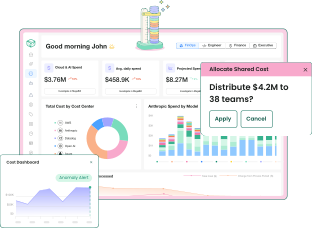
Track cloud, Kubernetes, and AI costs in the same system, with context both engineering and finance can trust. Specialized agents scan for waste, investigate anomalies, and route action to Jira, Slack, and ServiceNow-  automatically. 

Visibility_icon

Unit economics inside FinOps

Connect spend to customers, products, and features without pushing the real analysis into BI tools or spreadsheets. Decisions are made where the data lives.

Unit-economics-icon
WHY FINOUT

The FinOps platform that enterprises can actually scale with

Finout is built around three pillars that mature FinOps teams can't operate without: visibility into the past, confidence in the future, and ownership that scales across the org.

Analyze-the-past ANALYZE THE PAST

Full visibility across every cost source

Finout unifies cloud, Kubernetes, AI services, and SaaS into a single data layer, with costs fully allocated to business owners, not just infrastructure tags. Every dollar accounted for, in one place.

  • AWS, GCP, Azure, OCI unified in one view
  • Kubernetes cost visibility - cloud agnostic
  • AI services - OpenAI, Anthropic, Bedrock
  • 100% allocation, with or without tags
  • Shared cost distribution with configurable models
Plan-the-future PLAN THE FUTURE

Budgets & forecasts built on data you trust

Budgets and forecasts built on fully allocated, real-time cost data, not exports or approximations. Ownership logic updates as the org changes, so financial plans remain valid without manual intervention at month end.

  • Budgets built on fully allocated data
  • Forecasts that stay accurate as infrastructure changes
  • Anomaly detection across all cost sources
  • Unit economics- cost per customer, product, feature
  • Consistent data for both finance and engineering
Adapt-FinOps-at-scale ADAPT FINOPS AT SCALE

Cost accountability across the org

FinOps only works when it reaches beyond the central team. Finout pushes cost data, alerts, and accountability into the tools engineering already uses-  making ownership a default, not a follow-up. Billy answers cost questions in plain English. Agents detect, investigate, and act automatically. 

  • Billy: Ask anything, get chart-backed answers from live Finout data
  • Detection, Investigation & Orchestration agents- From scan to savings, automatically
  • AI Governance: Set Account Instructions once, every AI feature follows
  • Cost alerts in Jira, Slack & ServiceNow
  • Team-level showback, no manual prep
  • Ownership structure updated as the org evolves
  • Automated waste detection across all infrastructure
  • Cost accountability distributed across engineering teams

Finout is the system of record four teams can agree on

FinOps_teams

FinOps teams

A governed system of record, not another reporting layer you will outgrow.

EngineeringLeaders

Engineering leaders

Cost accountability embedded directly in the tools engineers already use.

Finance-FPandA

Finance & FP&A

Accurate, auditable data to plan and forecast with confidence every month.

PlatformAndDevOps

Platform & DevOps

Built for Kubernetes, shared infra, and multi-cloud complexity from day one.

SOCIAL PROOF

Why leading FinOps teams chose Finout

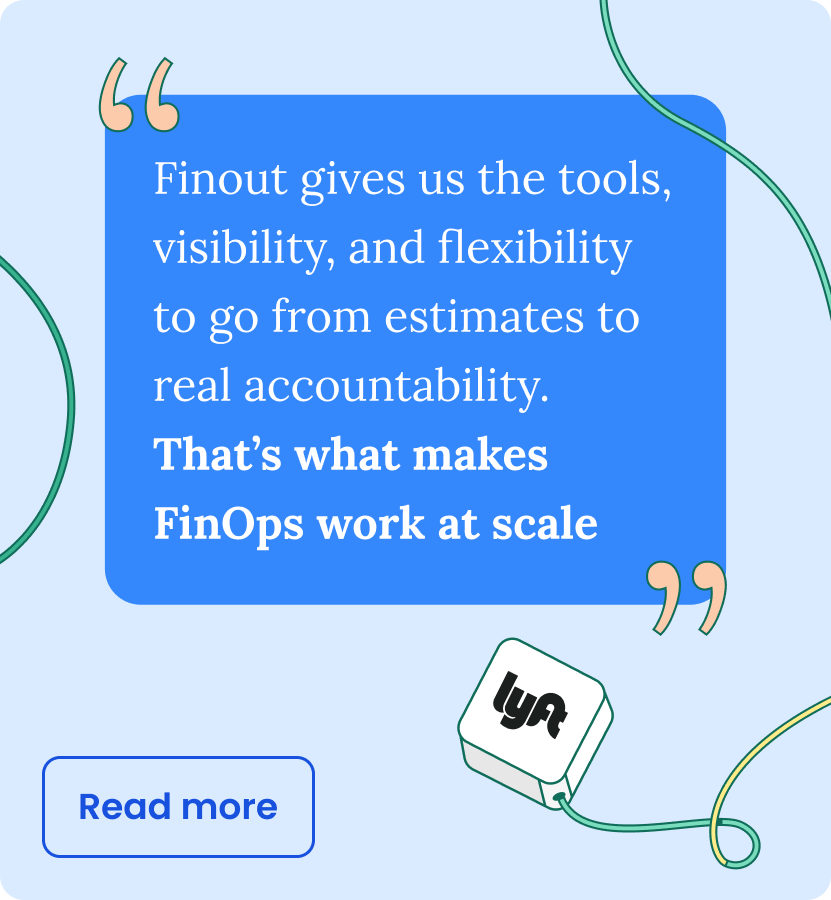
Finout gives us the tools, visibility, and flexibility to go from rough estimates to real accountability. And that’s what makes FinOps work at scale.

Finout didn’t just show us where costs were going – it helped us build the ownership model that made cost reduction stick across engineering teams

I have witnessed firsthand the impact of this partnership on our ability to make data-driven choices, reduce unnecessary spend, and accelerate innovation.

FAQ’s

01 What if our cloud tags are incomplete or inconsistent?

Finout’s Virtual Tagging engine decouples cost allocation from infrastructure tags. You can define rules based on resource names, metadata, namespaces, or accounts to allocate 100% of costs retroactively—without blocking engineers with tagging tickets.

02 Does Finout require installing software agents on our infrastructure?

No. Finout connects securely via standard read-only IAM roles and provider APIs. For Kubernetes, we leverage your native telemetry or Prometheus metrics without running invasive proprietary agents on your nodes.

03 How does Finout compare on total cost of ownership?

Unlike platforms that charge penalties as cloud spend increases or require mandatory professional service packages to configure basic dashboards, Finout provides predictable pricing that scales with your business value, with dedicated enterprise onboarding included.

04 How does Finout differ from native cloud billing tools?

Finout provides a unified FinOps platform that consolidates cost data across AWS, Azure, GCP, Kubernetes, and AI services into a single source of truth. Unlike native billing tools that only show raw usage data, Finout offers advanced allocation, showback/chargeback, and real-time cost anomaly detection across your entire infrastructure.

05 How does Finout differ from native cloud billing tools?

Finout provides a unified FinOps platform that consolidates cost data across AWS, Azure, GCP, Kubernetes, and AI services into a single source of truth. Unlike native billing tools that only show raw usage data, Finout offers advanced allocation, showback/chargeback, and real-time cost anomaly detection across your entire infrastructure.

06 Can Finout help with Kubernetes cost management?

Yes, Finout specializes in Kubernetes cost visibility by providing granular insights into pod, namespace, and cluster-level spending. The platform automatically allocates shared costs and integrates with your existing K8s environment to deliver accurate unit economics without requiring agents or complex configurations.

07 Does Finout support AI and machine learning cost optimization?

Finout offers comprehensive AI cost management capabilities, tracking spending across GPU instances, model training, inference workloads, and AI services like OpenAI and Anthropic. The platform helps teams understand AI unit costs, optimize resource utilization, and forecast future AI infrastructure needs as your models scale.

08 What is agentic FinOps?

Agentic FinOps is FinOps built for environments where automation and AI agents make infrastructure decisions faster than a person can review them. As AI workloads and automated agents multiply the number of cost decisions being made, allocation and governance need to update continuously instead of on a monthly cadence. Finout's own Detection, Investigation, and Orchestration agents scan for waste, investigate anomalies, and route action automatically, so cost governance can keep pace with agentic infrastructure instead of trailing behind it.

9 What is a MegaBill?

A MegaBill is Finout's term for a single, unified data layer that consolidates cloud, Kubernetes, AI, and SaaS costs into one place. Instead of pulling separate billing exports from each provider and reconciling them by hand, engineering and finance work from the same governed source of truth for allocation, reporting, and forecasting.

10 What are Virtual Tags?

Virtual Tags are Finout's approach to cost allocation that doesn't depend on traditional cloud resource tagging. Instead of relying on tags applied at the infrastructure level, which are frequently missing or inconsistent, allocation logic is defined directly in Finout. That means costs can still be assigned to the right owner even when tagging coverage is incomplete, which is where most allocation breaks down at scale.

The best FinOps teams run on Finout

Join Lyft, Wiz, Choice Hotels, Tenable, and many more leading teams who made the switch. 

aicpa-soc-and-focus-badge2