Union (3) FinOps for AI

Turn AI spend 
into ROI

Finout brings every AI cost into one view. Leadership gets the clarity to justify budgets and prove return. Engineering gets the metrics to cut waste, improve efficiency, and ship faster - all from a single platform.

Book a demo
ai-spend

The best FinOps teams run on Finout

New message from CFO
"Can someone explain why our AI spend went up 340% in Q3? What are we getting for it?" 😤
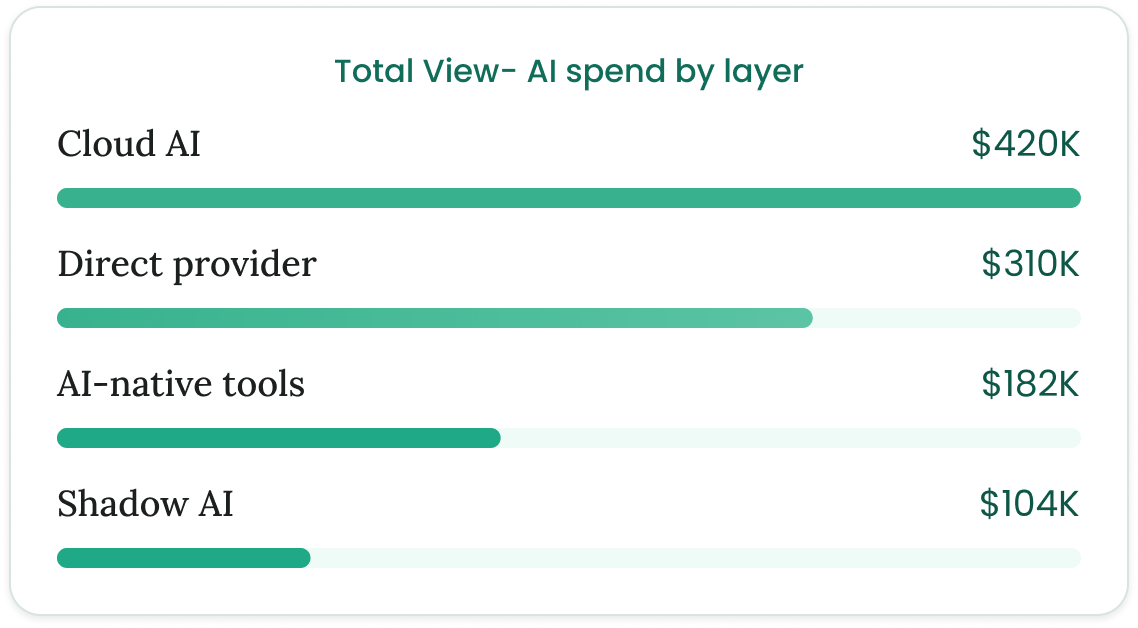
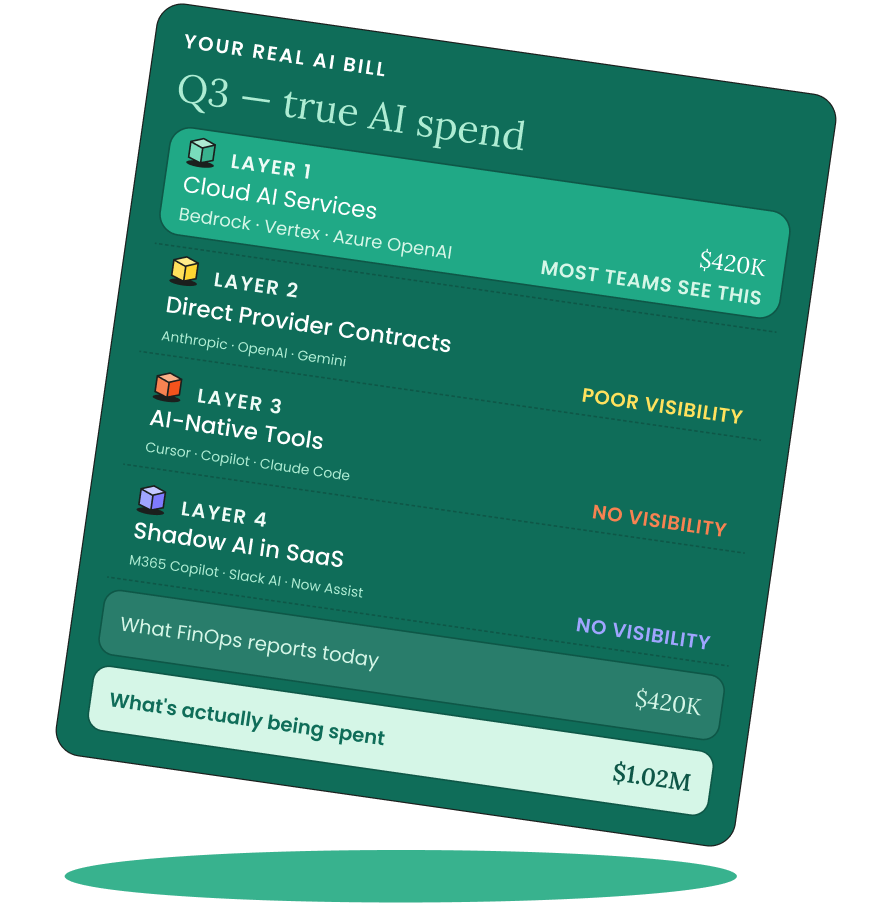
The 4-Layer AI Bill

Most FinOps teams handle Layer 1. 
The cost is hiding in the other three.

AI spend hides in invisible line items. Finout brings every cost into one view- so Finance proves ROI, Leadership justifies budgets, and Engineering cuts waste. 
Icon (9)
LAYER 1 - Usually visible

Cloud AI services

  • AWS (12)
  • GCP (2)
  • Azure (3)

Amazon Bedrock · Azure OpenAI · Google Vertex AI

Hyperscaler-managed AI, consumption-based and contained inside the cloud bill. 
The layer most FinOps teams already handle.

Icon (3)
LAYER 2 - Poor visibility

Direct provider contracts

  • Open AI
  • Azure (4)
  • AWS (13)

Anthropic · OpenAI API · Gemini API

Seven-figure commitments with pre-paid token floors that bypass the hyperscalers entirely. Separate invoices, console-level reporting at best.

Icon (5)
LAYER 3 - Blind spot

Token based tools

  • Open AI (1)
  • Azure (5)
  • AWS (14)

Cursor · Claude Code · GitHub Copilot · Windsurf

AI isn't a feature here - it's the product. Seat fees plus usage that runs $500–$2,000 per developer per month and climbs without warning.

Icon (8)
LAYER 4 - Blind spot

AI in existing SaaS stack

  • Notion
  • Attlasian
  • Slack (1)

M365 Copilot · Slack AI · Agentforce · Now Assist

AI switched on inside tools you already buy. The charges hide inside
existing vendor line items — the layer nobody is allocating.

Finout unifies all four layers into one platform, so nothing is hidden.

Ingest every source. Allocate to teams. Catch anomalies. Report ROI in one dashboard, zero blind spots.

HOW FINOUT DOES IT

Tokens are the new unit of cost. 
Put them in context.

The MegaBill is Finout's unified cost model- cloud, Kubernetes, SaaS, and now every AI layer normalized in one place. Same allocation rules. Same owners. No spreadsheets.

ROI

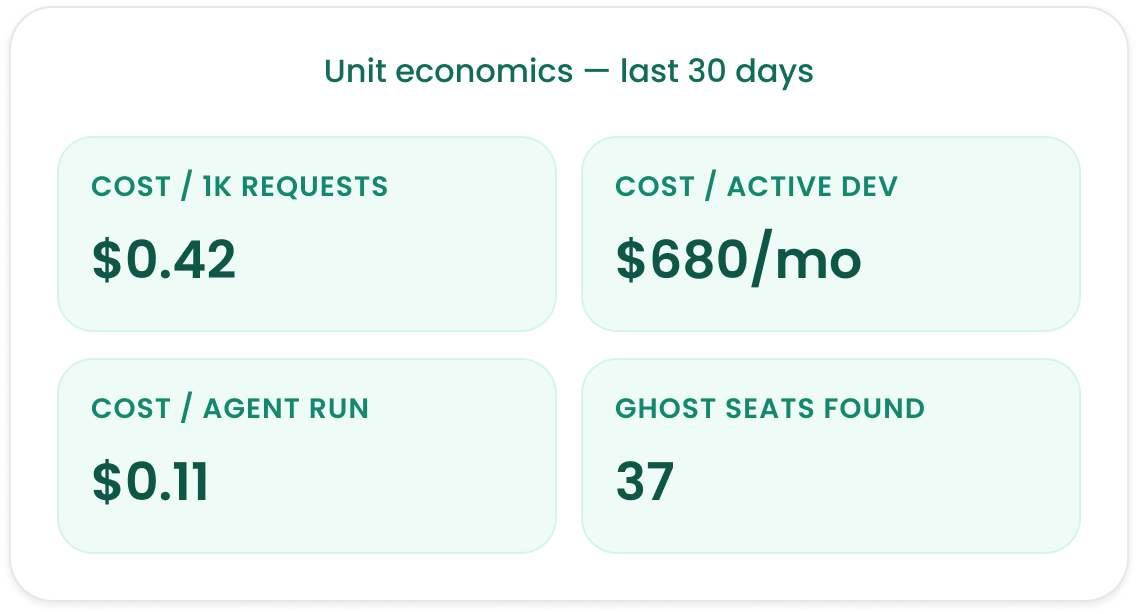
Measure AI ROI, not just AI spend

  • Unit economics: cost per request, per customer, per agent run.

  • Map AI-native tool spend to developer output and utilization.

  • Eliminate ghost seats and overlapping tools.
Unit_economics

Unify

Every layer in one MegaBill

  • Native ingestion for Bedrock, Vertex, Azure OpenAI, OpenAI and Anthropic. 

  • AI Gateway support- Portkey, LiteLLM, native gateways 

  • Deeper Kubernetes enrichment to GPU, node and pod level.
total-view

Allocate

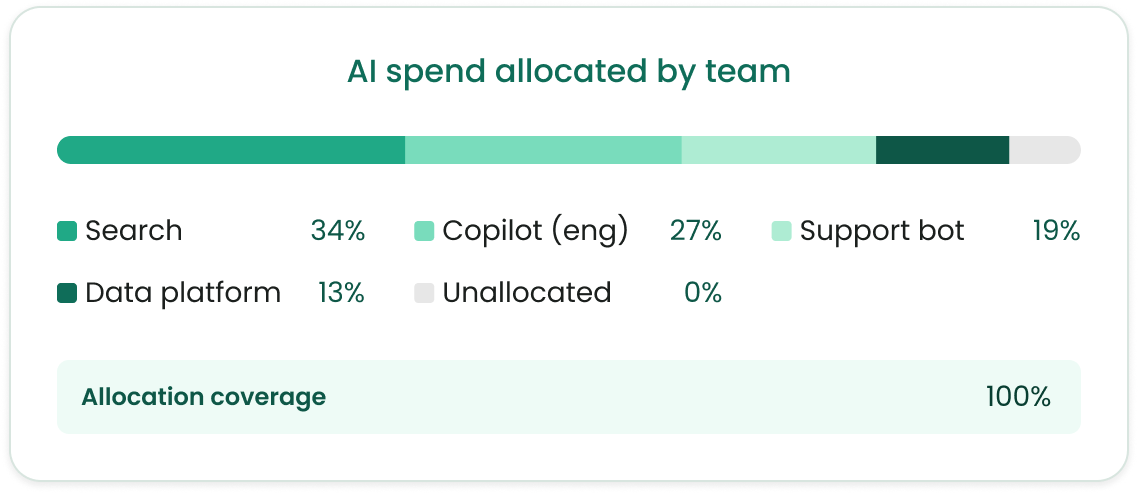
Close the gap between spend 
and ownership

  • Per-token, per-model, per-team, 
per-agent granularity.

  • AI-Powered Virtual Tags keep allocation in sync as you grow.
  • 100% allocation coverage, CFO-ready.
spend-by-team

Control

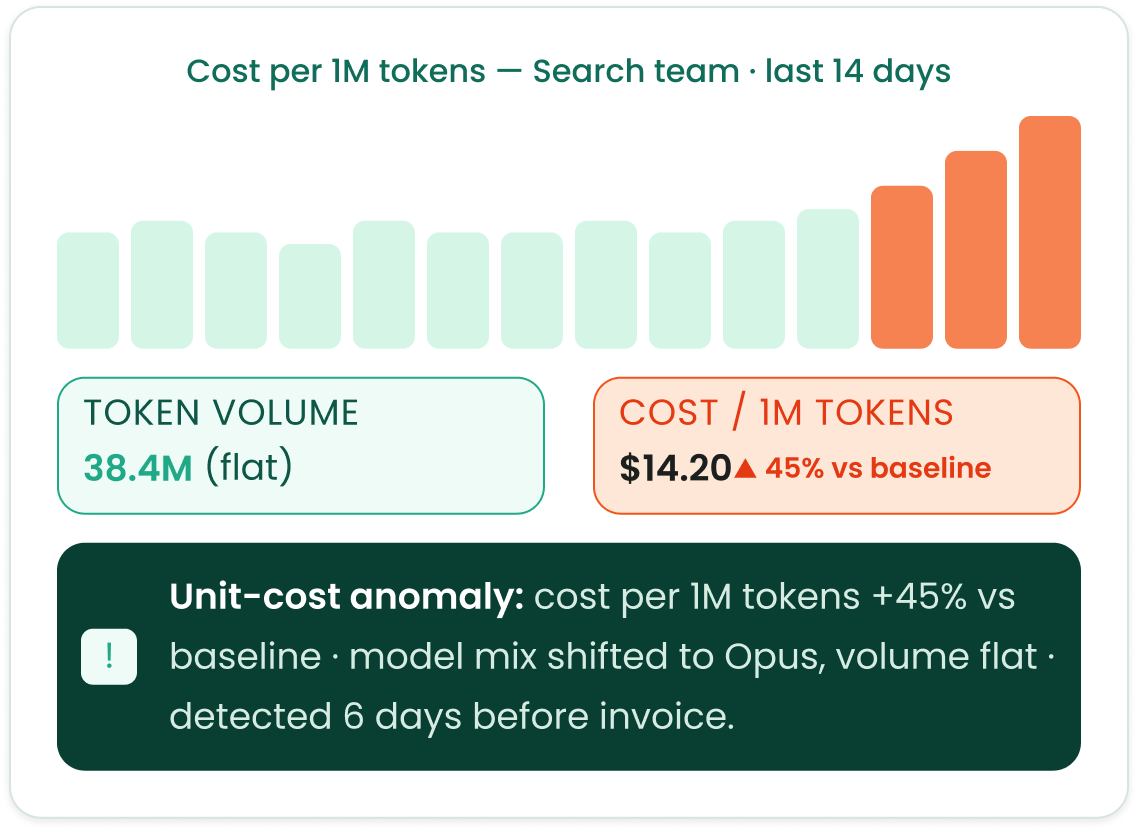
Catch the spike before it's a board conversation

  • Anomaly detection tuned to per-model and per-team baselines.

  • Unit-economics anomalies- Alert on cost per million tokens, not just total spend, so you catch a pricier model mix even when volume looks flat.
  • Alerts routed to Slack with the owner attached.
  • Budgets and forecasts that treat AI as a first-class 
cost driver.
search-team
Token efficiency & unit economics

See which teams use AI efficiently- and which waste it

Allocation tells you whose spend it is. Efficiency tells you whether it was worth it. Finout normalizes every team and developer to the same unit- so the outliers surface on their own.

You pay in dollars. You consume in tokens. Almost no one can connect the two-so we built the view that does.

The signals that expose an outlier

Icon (10)

Model fit

Opus on trivial tasks, GPT-5 where a small model would do. The wrong model is the most common waste.

Icon (11)

Cache hit rate

Low cache reuse means you're paying full price for prompts you've already run.

Icon (12)

Input/ output token ratio

Bloated context windows and runaway generations show up here first.

Icon (13)

Cost per outcome

Cost-per-commit, per-request, per-resolved-ticket — spend tied to something the business recognizes.

An outlier isn't a verdict. There's often a good reason a team lives on the most expensive model- they just need to be able to defend the anomaly. The job isn't to police spend. It's to start the conversation.
Built for the people building with AI

Token efficiency for entrepreneurs

Whether you're 12 engineers or 1,200, the question is the same: are these tokens buying growth, or burning runway? Finout gives founders and operators the unit economics to answer it.
Founder-led, < 20 engineers

The Builder

Every token is runway. Finout shows cost per feature so you ship without surprising the next board update.

Scaling Series B → C

The Operator

AI spend just overtook infra. Allocate to teams, defend the burn, and tie tokens to outcomes finance recognizes.

Enterprise, AI-native pivot

The Reinventor

Legacy P&Ls weren't built for tokens. Bring four layers into one MegaBill so leadership can price what they sell.

Plug in. See costs. Done.

One-click integrations across every major AI provider.

Loading
AWS-Bedrock-logo
Github_copilot-logo
GCP-Vertex-logo
fal.ai-logo
Cohere-logo
Sagemaster-logo
Cursor-logo
Anthropic-logo-1
OpenAI-1-logo

Don't see your stack? We're adding new integrations constantly.

Request an integration
Tokens are becoming the atomic unit of cost. The teams that win won't be the ones that see their AI spend- they'll be the ones who can allocate it.

AL

Asaf Liveanu

Co-Founder & CPO, Finout

FAQs

01 What is FinOps for AI?

FinOps for AI applies the same financial accountability practices used for cloud cost management, visibility, allocation, and optimization, to AI and LLM spend such as API usage, GPU inference, and token consumption. It brings AI spend into the same shared-ownership model finance and engineering already use for cloud infrastructure, rather than treating it as a separate, harder-to-track cost.

02 Why is AI spend hard to track across cloud providers, AI-native tools, and existing SaaS?

AI spend arrives through at least four different channels, and only one of them is easy to see. Hyperscaler-managed AI like Amazon Bedrock, Azure OpenAI, and Google Vertex AI shows up inside the existing cloud bill. Direct provider contracts with Anthropic, OpenAI, and other model providers arrive as separate invoices with limited reporting. AI-native tools like Cursor, Claude Code, and GitHub Copilot bill per seat plus usage that can climb without warning. And AI features already switched on inside tools like Microsoft 365 Copilot or Slack AI hide inside vendor line items nobody is allocating. Most teams only have visibility into the first layer.

03 What is AI cost allocation, and why is it harder with token-based pricing than with traditional cloud spend?

AI cost allocation is the process of mapping AI spend, tokens, inference calls, API usage, to the team, feature, or agent that generated it. It is harder than traditional cloud allocation because token-based pricing does not follow the same tagging conventions cloud resources do. A single request in an agentic workflow can trigger multiple model calls across different models and providers, and that spend has to be attributed after the fact rather than tagged at the resource level the way an EC2 instance can be.

04 What is AI unit economics, and how is it different from just tracking AI spend?

Tracking AI spend tells you what was paid. AI unit economics tells you whether that spend generated value, by measuring cost per request, per customer, or per agent run rather than a single monthly total. That distinction is what lets finance defend a budget and lets engineering see which teams are getting real output from their AI spend and which are burning tokens without a return.

05 Which AI providers and tools does Finout connect to?

Finout natively ingests Amazon Bedrock, Google Vertex AI, Azure OpenAI, OpenAI, Anthropic, Cursor, GitHub Copilot, and fal.ai, with AI gateway support for Portkey and LiteLLM. New integrations are added on an ongoing basis, and additional tools can be requested directly.

06 Do I need to change my code or add instrumentation to use this?

No. Integrations are one-click across the supported AI providers, consistent with how Finout connects to cloud and Kubernetes sources elsewhere on the platform. No SDKs, no agents, and no changes to how your teams call AI providers today.

See your real AI costs-and turn them into ROI

Combine your AI spend and we'll show you what's hiding outside your cloud bill, and who it belongs to.