












What Is the Harness Cloud Cost Management Platform?
Harness Cloud Cost Management is a platform to help organizations control and optimize their cloud spending. It supports multi-cloud environments, including AWS, Azure, Google Cloud, and Kubernetes.
Harness provides granular cost visibility, automation, and policy-based governance to help improve cost attribution, budgeting, and resource efficiency. Teams can define cost categories, track usage by team or application, and identify idle resources. It also provides anomaly detection which helps users detect and respond to unexpected cost spikes.
Harness also provides tools for commitment management and cluster optimization, enabling organizations to manage activities like reserved instance planning, savings plans optimization, and Kubernetes node scaling.
Editor’s note: Updated Harness product information to reflect features, pricing, and limitations in 2026, updated information for Harness competitors, and added one new competitor.
This is part of an extensive series of guides about FinOps.
Key Features of Harness Cloud Cost Management
Here are the key capabilities that help organizations manage and reduce cloud costs across multiple environments:
- Granular cost visibility: Provides detailed insights into costs at the level of clusters, namespaces, workloads, nodes, pods, and labels, including breakdowns of utilized, idle, and unallocated spend
- Cost forecasting: Estimates future cloud spending based on historical usage data to support planning and budgeting
- Cost optimization tools: Identifies idle or underutilized resources and provides recommendations, along with automated actions such as stopping unused resources
- Automated resource control: Uses rules like AutoStopping to reduce waste by shutting down inactive resources without manual intervention
- Cost governance and budgeting: Enables teams to define budgets, set thresholds, and configure notifications to monitor and control spending
- Anomaly detection: Detects unusual spending patterns and cost spikes, helping teams investigate and respond quickly
- Commitment management: Supports planning and optimization of reserved instances and savings plans to improve cost efficiency
- Cluster optimization: Provides orchestration capabilities for managing Kubernetes clusters, including resource allocation and scaling decisions
- Cost categorization and allocation: Organizes cloud costs by applications, teams, or environments for more accurate attribution and analysis
Harness Pricing Packages
Harness offers three pricing tiers: Free, Essentials, and Enterprise. The cloud cost management features are only offered in the Enterprise plan. Other plans include Harness’s CI/CD and GitOps capabilities.
Free
This plan is intended for individual developers and small teams. It provides access to a basic open source platform that supports core software delivery lifecycle management. It includes tools such as Harness Open Source and Litmus Chaos to get started with DevOps workflows.
Essentials
Designed for growing organizations with small to mid-size teams, the Essentials plan includes a set of packaged modules for continuous software delivery. It provides standard support and focuses on improving operational efficiency. The main features under this plan include:
- Continuous delivery and GitOps
- Continuous integration
- Infrastructure as code management
- Security testing orchestration
Enterprise
The Enterprise tier is intended for large-scale organizations with complex requirements. It offers the most flexibility, allowing teams to select individual modules based on their specific needs. This plan includes advanced features, dedicated support, and a broader set of tools across five solution areas:
- Modernizing DevOps: Adds artifact registry, feature management, chaos engineering, service reliability, and database DevOps
- Improving developer experience: Offers insights, internal developer portals, and cloud dev environments
- Secure software delivery: Expands security with software supply chain capabilities
- Optimizing cloud spend: Includes cloud cost management tools
- Custom support: Provides premium support and access to a dedicated account manager
Pricing for the Essentials and Enterprise plans are available upon request.
Harness Limitations
While Harness Cloud Cost Management offers features for optimizing cloud spending and visibility, there are some limitations that users should be aware of. These limitations were reported by users on Trust Radius:
- Limited publicly available pricing details: Pricing information is not clearly provided, requiring direct contact with the vendor for cost estimates
- Limited user feedback on cloud cost management: There are relatively few user reviews specifically covering the cloud cost management capabilities, making it harder to assess real-world performance
- Primarily focused on CI/CD use cases: The platform is widely reviewed for continuous delivery and DevOps workflows, with less emphasis and validation around cost management features
- Dependence on user familiarity: While setup is described as straightforward, users indicate that the platform becomes effective only after gaining familiarity with its features and workflows
Notable Harness Competitors
Dedicated FinOps Platforms
1. Finout

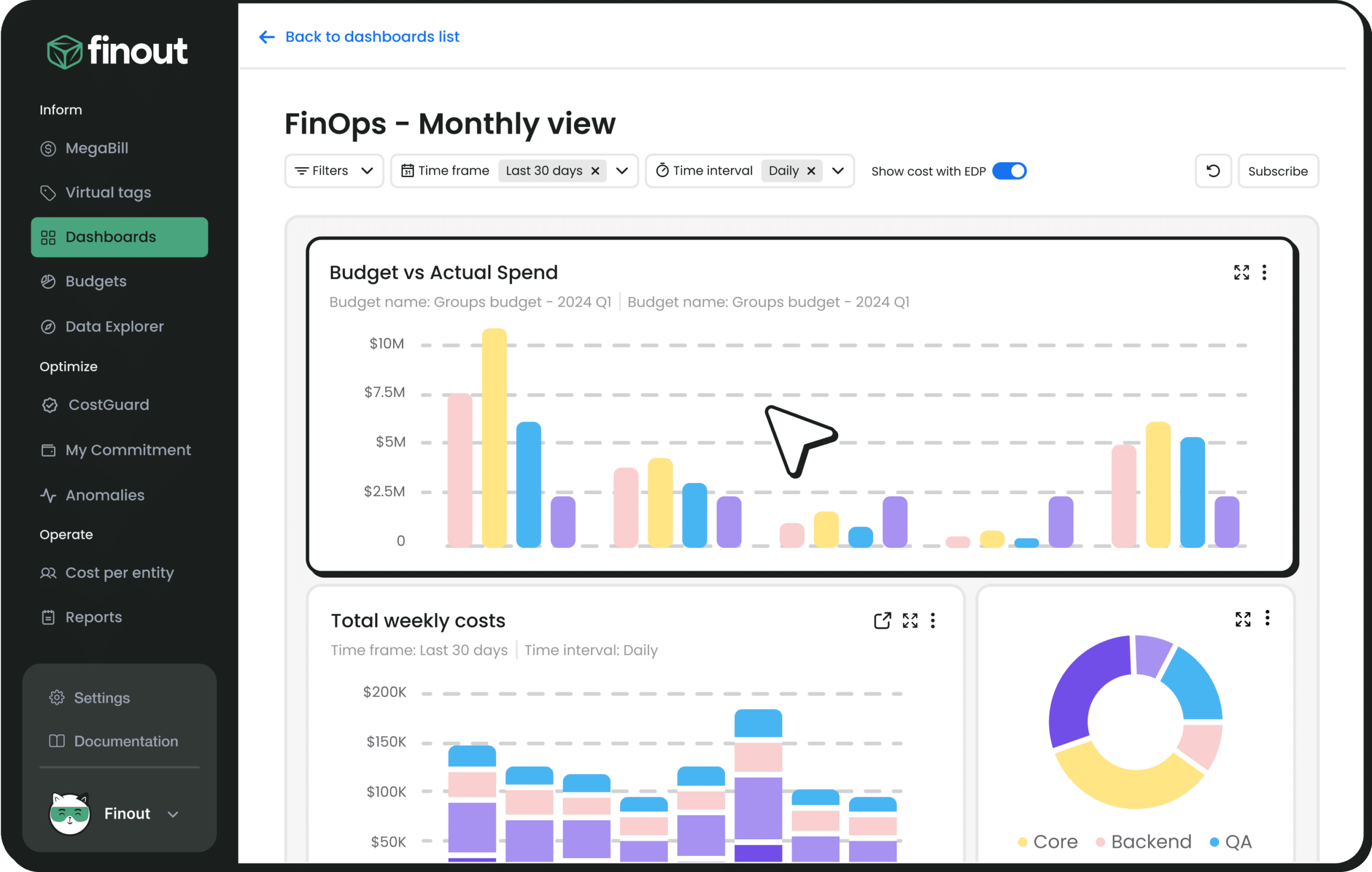
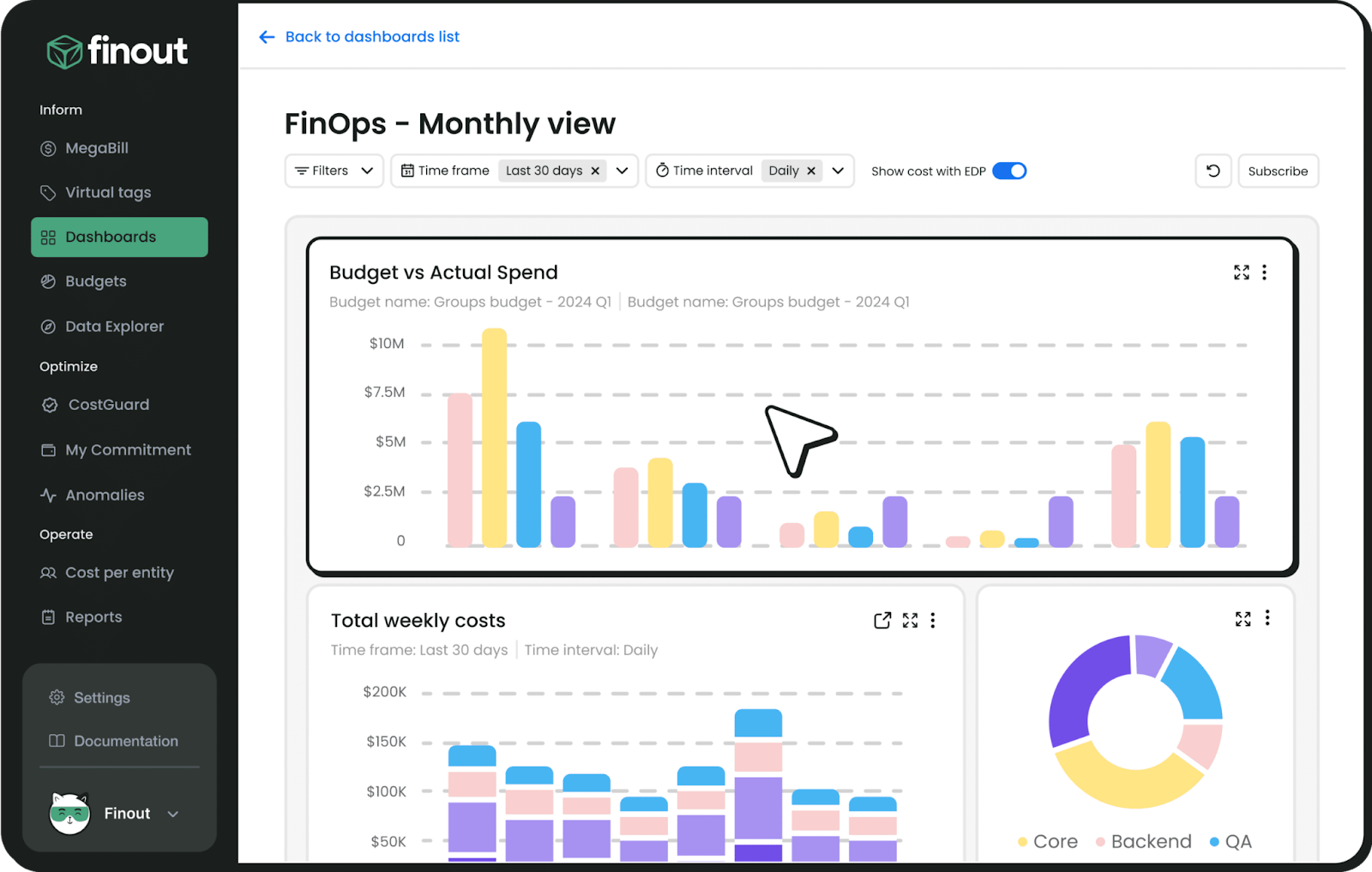
Finout and Harness both provide cost management, but they’re built on very different foundations. Harness cost management is an add-on to a broader CI/CD and DevOps platform, which makes it useful but limited—it wasn’t designed with FinOps as the core discipline. Finout, on the other hand, was built from the ground up for cloud cost management and FinOps at enterprise scale. That means its architecture, data model, and integrations are purpose-built to give engineering and finance teams shared visibility into spend, with the granularity and flexibility needed for modern multi-cloud and SaaS-heavy environments. In short, Finout is not a bolt-on—it’s a modern, specialized tool for doing FinOps effectively today.
On top of that, Finout’s FinOps suite goes beyond basic cost allocation. It provides complete capabilities for unit economics, anomaly detection, forecasting, and automated reporting, all in a single platform. This makes it easier for organizations to operationalize FinOps practices without stitching together multiple tools or relying on manual processes. The suite is designed to support collaboration between engineering, finance, and business teams—ensuring cost data isn’t just tracked, but actually used to drive better decisions at scale.
Source: Finout
2. YotaScale

YotaScale is a cloud cost management platform to provide visibility into cloud spending across complex environments. It focuses on helping engineering and FinOps teams understand cost drivers at a granular level, with real-time insights, allocation capabilities, and forecasting tools. The platform supports multi-cloud environments and emphasizes actionable alerts and reporting.
Key features:
- Granular cost visibility: Provides real-time insights into cloud spend across services, teams, and individual engineers, with the ability to drill down into detailed usage data
- Cost allocation: Enables precise attribution of costs, including handling untagged or inconsistently tagged resources and normalizing tags across environments
- Anomaly detection and alerts: Identifies cost spikes in real time and notifies responsible teams with contextual alerts
- Optimization recommendations: Offers workload-level insights and rightsizing guidance based on compute, memory, and network usage
- Budgeting and forecasting: Supports predictive budgeting, forecasting, and recommendations for commitment-based discounts such as savings plans and reserved instances
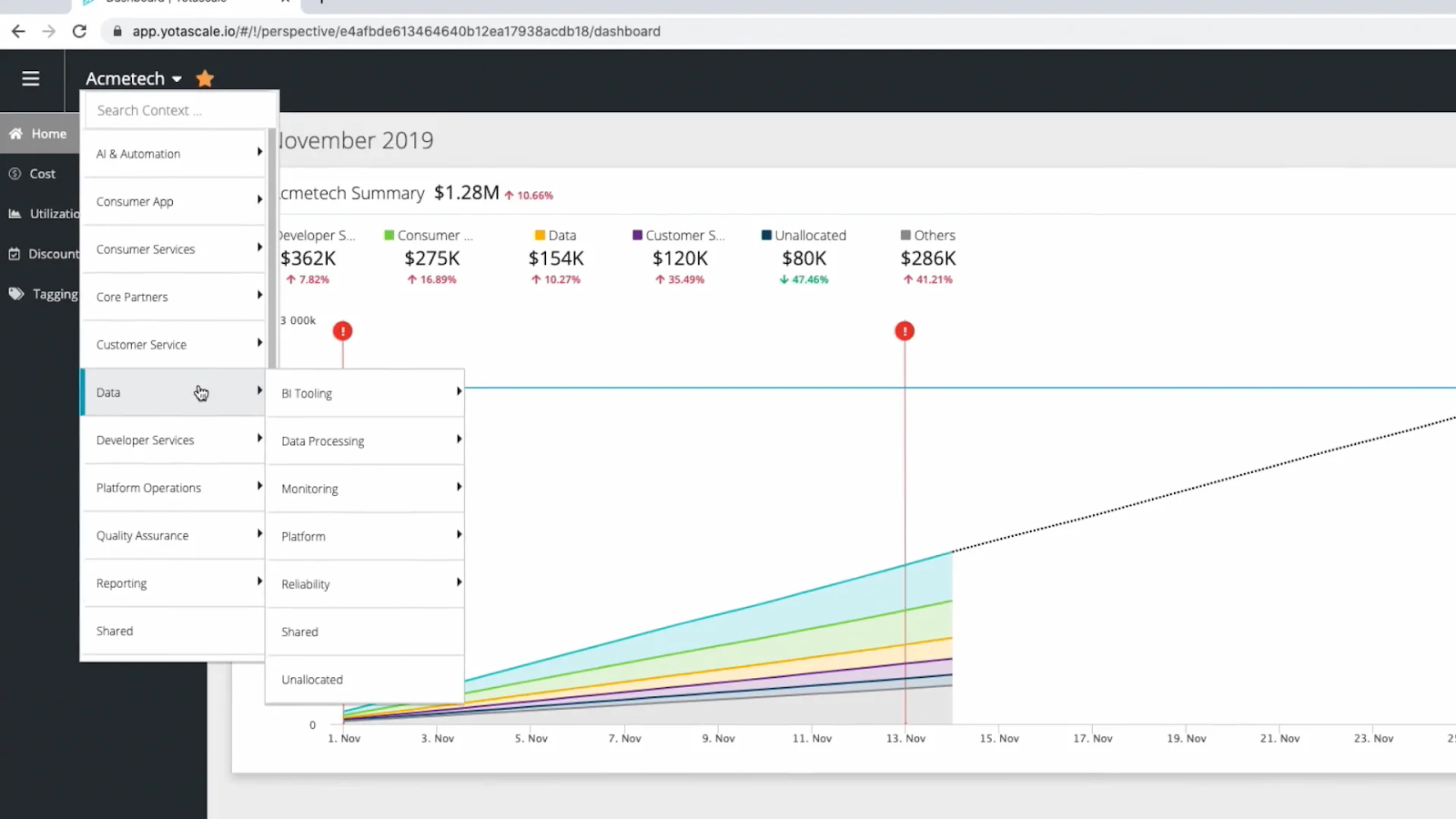
Source: Yotascale
3. Pelanor

Pelanor is a cloud cost management platform that focuses on organizing and analyzing cloud spend through customizable dimensions, reporting, and integrations. It enables teams to build cost views aligned with business context and supports monitoring and alerting for cost anomalies. The platform integrates with major cloud providers and services, allowing centralized visibility across environments.
Key features:
- Custom dimensions and segmentation: Organizes cost data using business-relevant categories and segments for more meaningful analysis
- Reporting and dashboards: Enables creation of custom reports and dashboards, with scheduling and export capabilities
- Anomaly monitoring: Supports rule-based alerts to notify teams of unusual cost behavior
- Budget management: Allows teams to define and track budgets across different scopes
- Multi-cloud and service integrations: Connects with AWS, Azure, GCP, Kubernetes, and data platforms to consolidate cost data
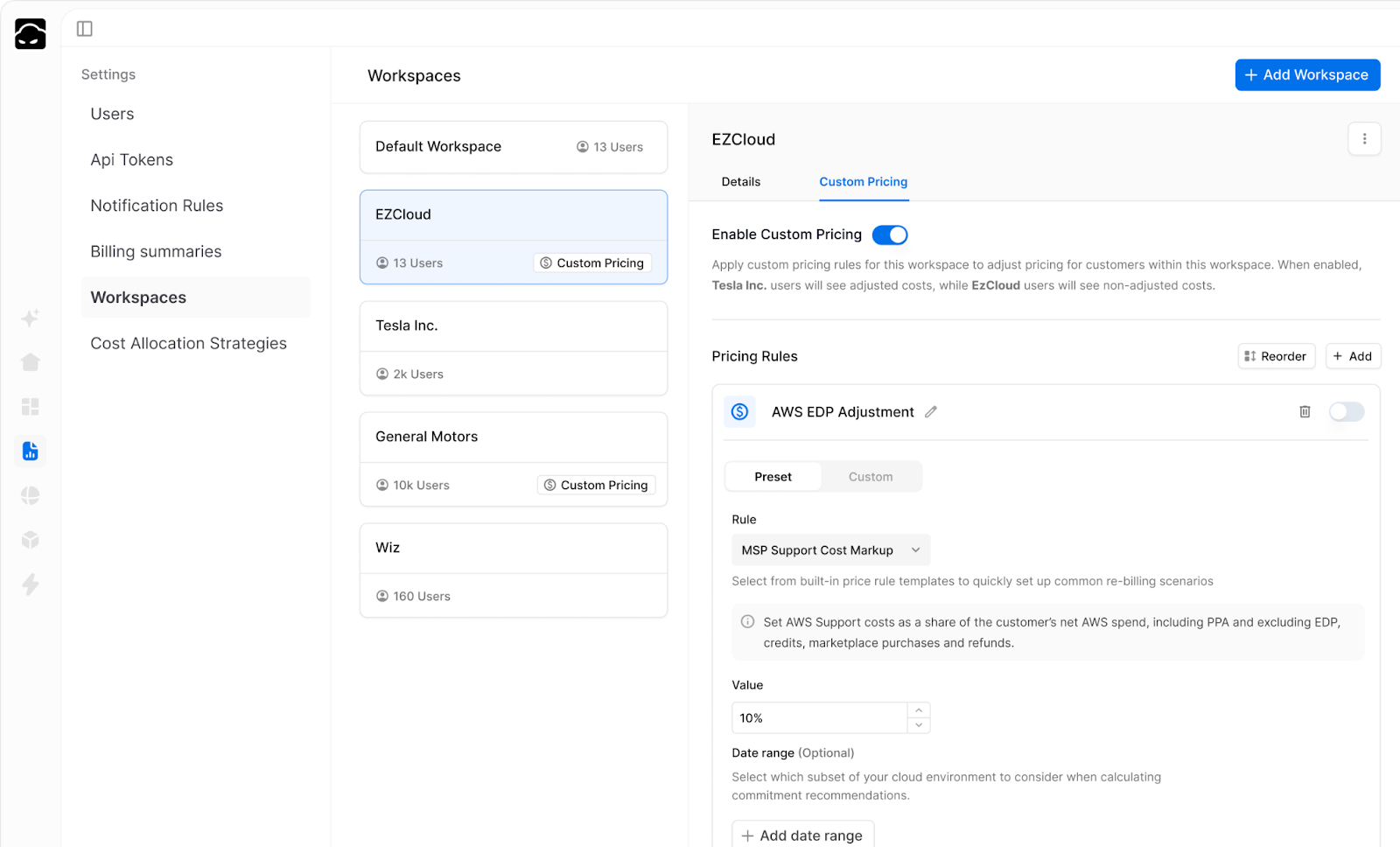
Source: Pelanor
46. IBM Cloudability

IBM Cloudability is a FinOps platform that helps organizations manage and optimize cloud spending across multiple providers. It provides visibility into cloud usage, supports cost allocation and forecasting, and enables teams to connect cost data with business outcomes. The platform is designed to support collaboration between finance, engineering, and operations teams.
Key features:
- Multi-cloud cost visibility: Provides insights into cloud, container, and application costs across environments
- Anomaly detection: Identifies unusual spending patterns and helps reduce waste
- Commitment management: Automates coverage for commitment-based discounts such as reserved instances and savings plans
- Unit economics analysis: Connects cloud spend to business metrics to evaluate cost efficiency and profitability
- Optimization automation: Supports performance-aware automation of cost optimization actions
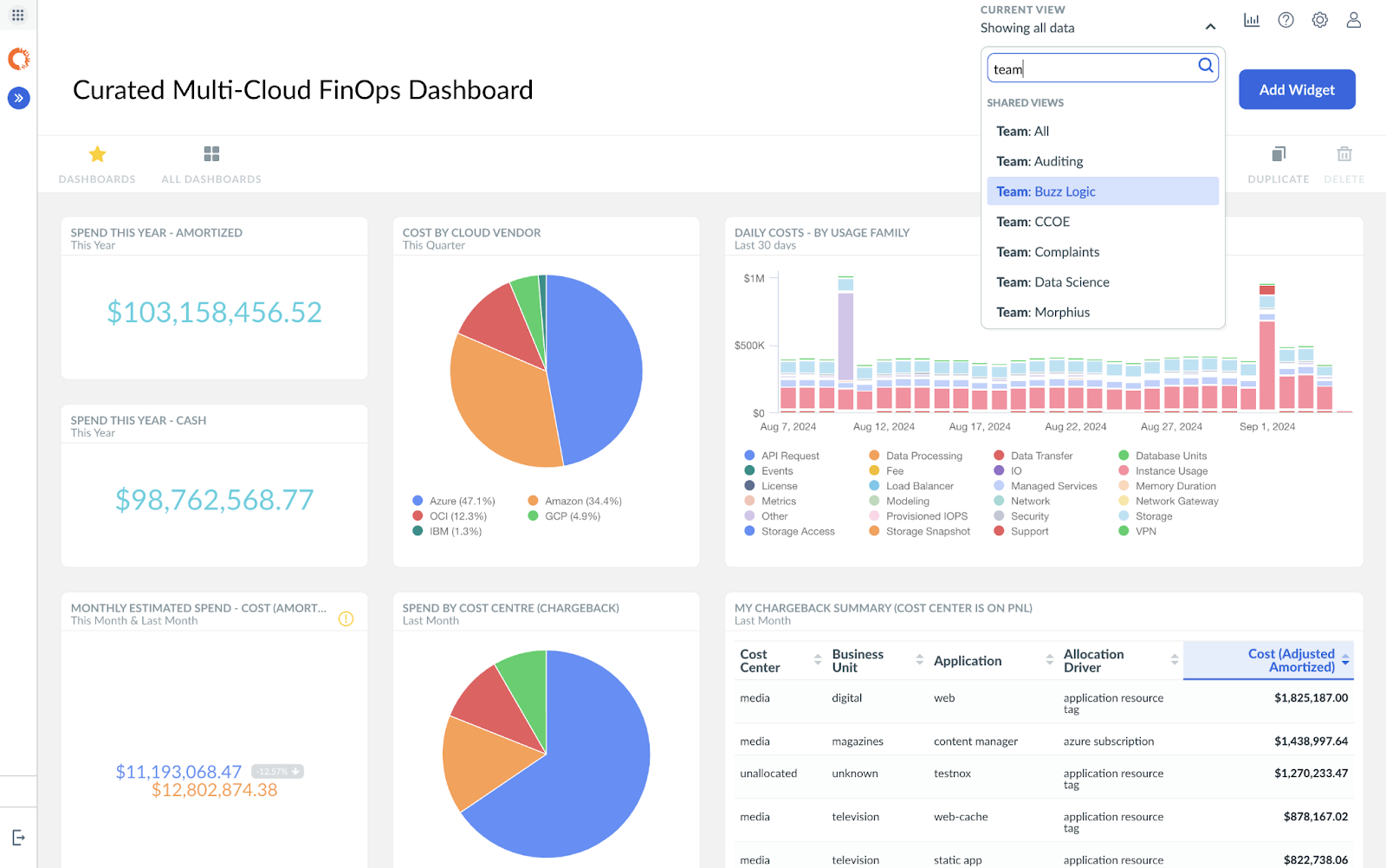
Source: Apptio
5. CloudZero

CloudZero is a cloud cost intelligence platform that focuses on connecting cloud and AI spending to business outcomes. It emphasizes cost allocation and unit economics, helping teams understand not just how much they spend, but why. The platform integrates cost data with usage telemetry to provide deeper insights into cost drivers and support decision-making across engineering and finance teams.
Key features:
- Cost allocation for complex environments: Allocates shared and variable costs using an advanced allocation engine, even when tagging is incomplete
- Unit economics tracking: Links cloud costs to business metrics such as cost per customer or feature
- Integrated cost and usage data: Combines billing data with telemetry to provide context for spending decisions
- Anomaly detection and analysis: Helps teams investigate unexpected cost changes and understand root causes
- Multi-source integrations: Supports data ingestion from multiple cloud, data, and AI platforms for unified analysis
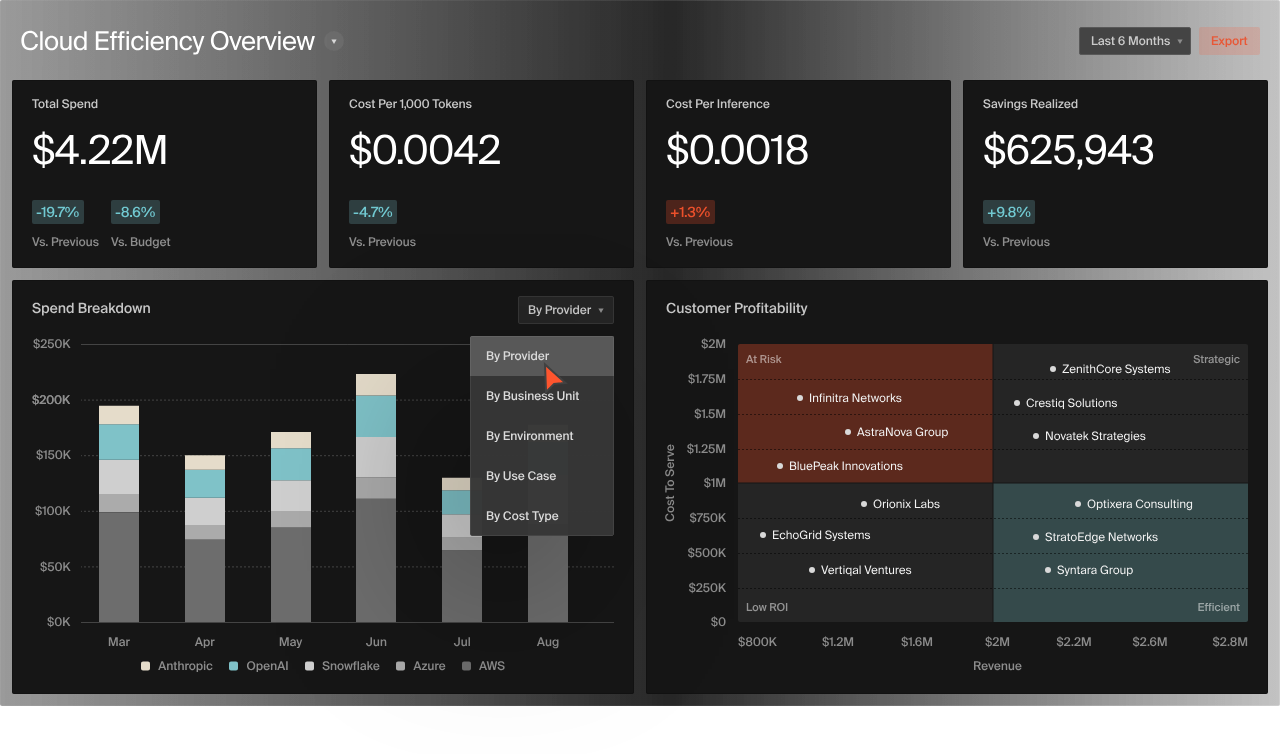
Source: CloudZero
Cloud Management Platforms with FinOps Capabilities
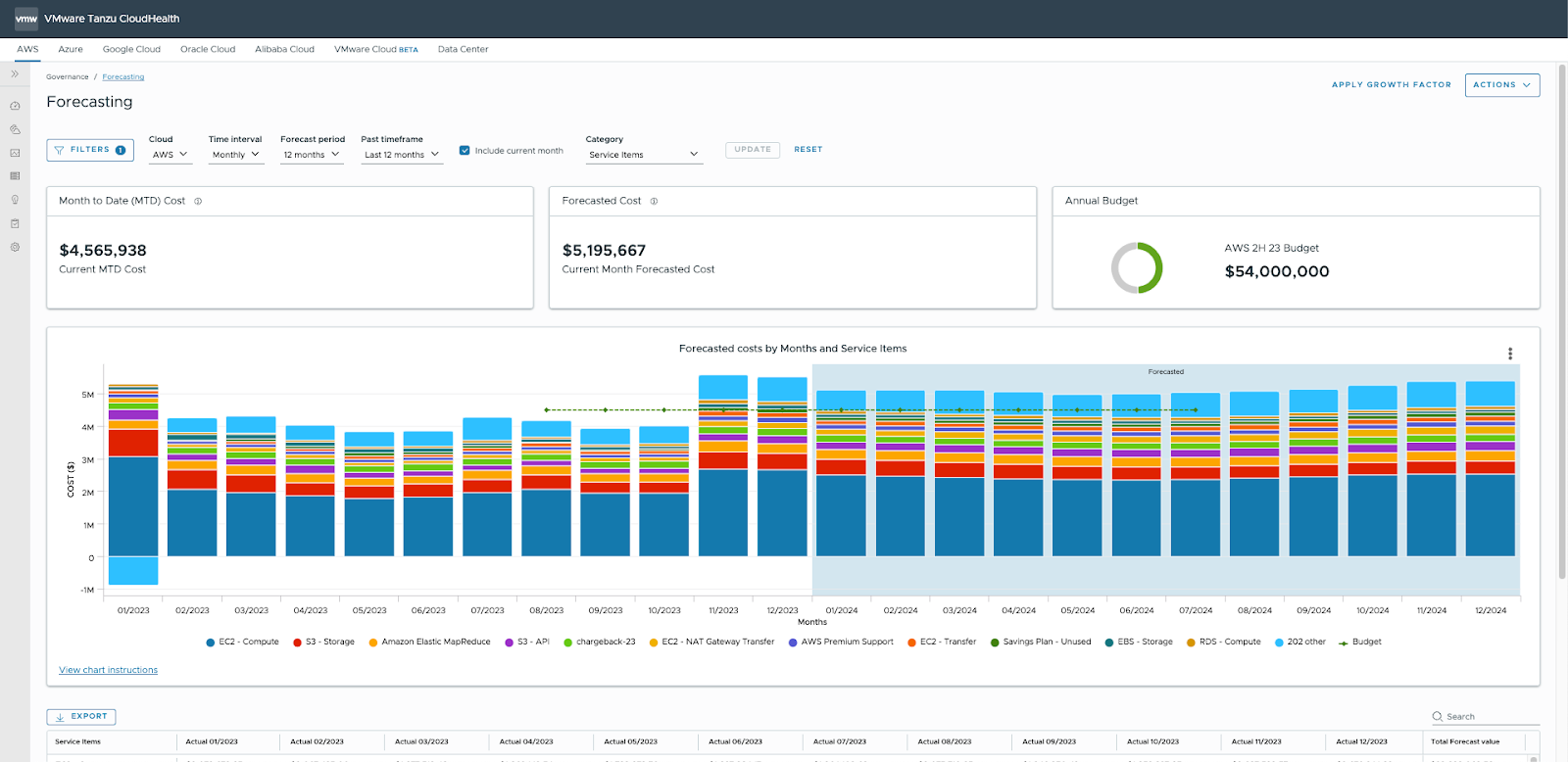
6. Cloudhealth

CloudHealth is a multi-cloud management platform that provides cost visibility, governance, and optimization capabilities. It is intended for large-scale environments and supports collaboration across FinOps teams by offering detailed reporting, policy enforcement, and resource management tools.
Key features:
- Granular reporting: Enables detailed analysis of cloud usage and costs with customizable reports
- Multi-cloud optimization: Provides recommendations to improve efficiency and reduce waste across cloud environments
- Governance and access control: Supports role-based access, delegation, and policy enforcement across organizations
- Asset management: Identifies idle or underutilized resources such as unused storage or virtual machines
- AI-assisted insights: Uses built-in assistants to generate reports and provide recommendations
Source: VMware
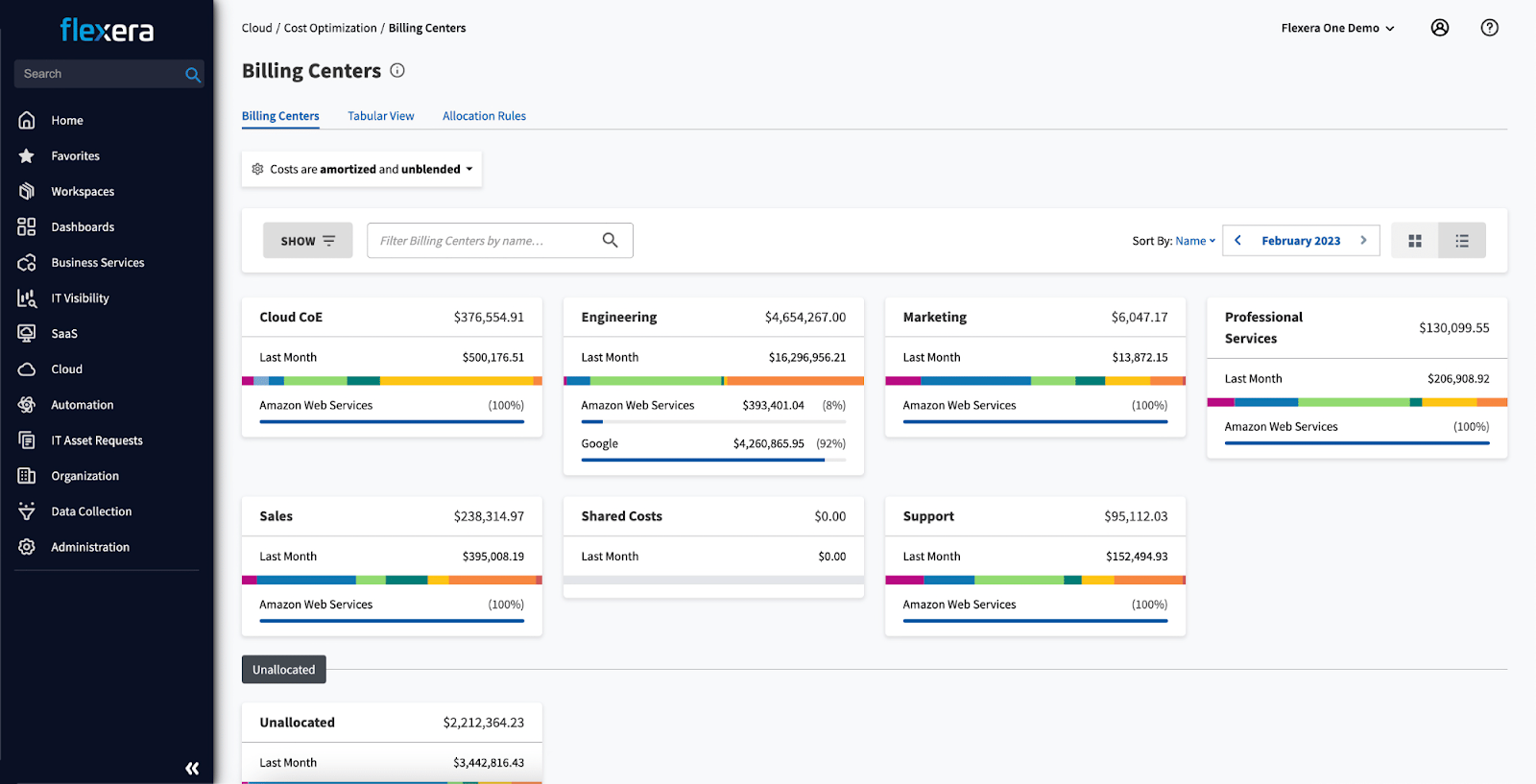
7. Flexera One

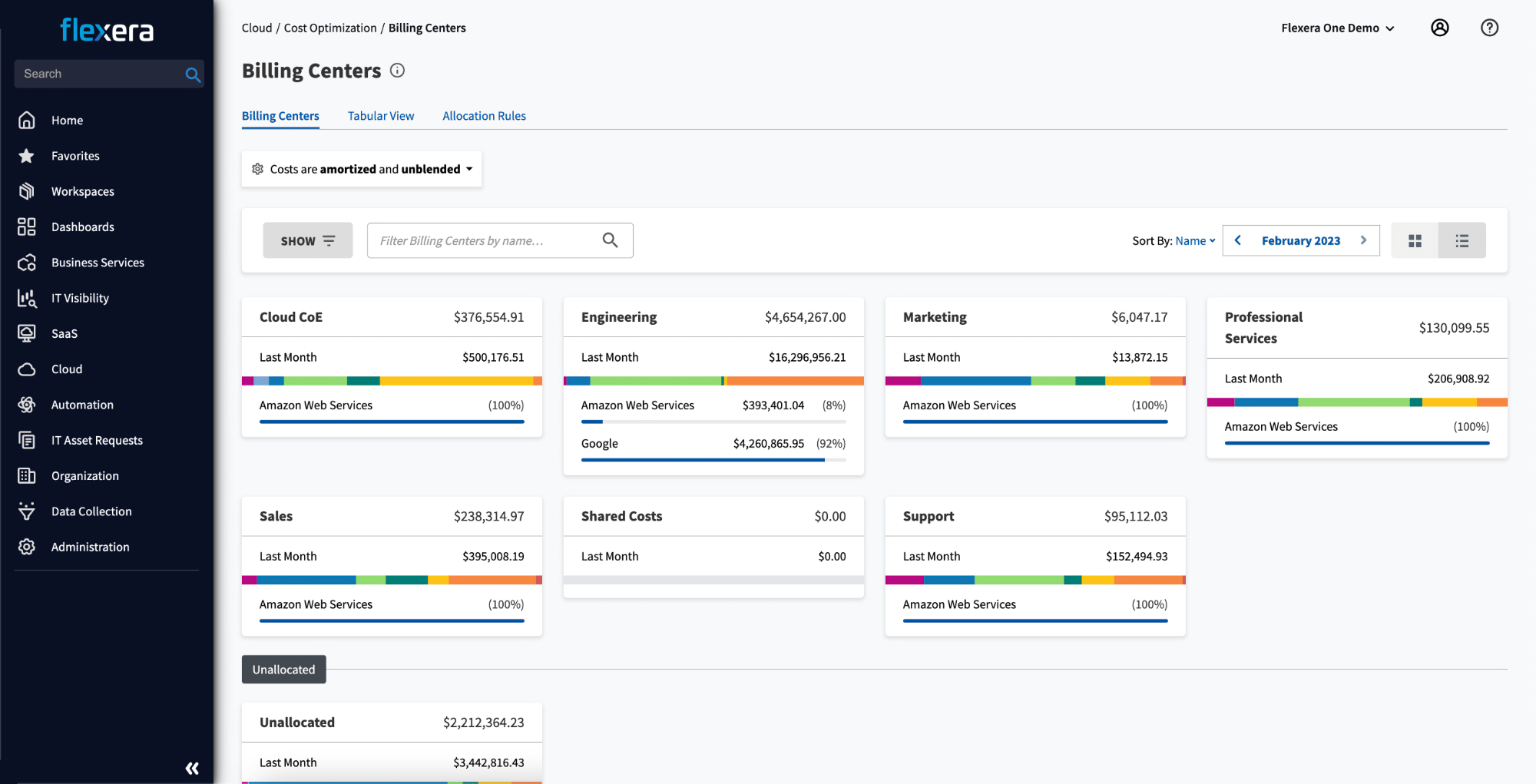
Flexera One is a platform that combines FinOps with IT asset management to provide visibility and control across hybrid IT environments. It helps organizations track spending across cloud, SaaS, and on-premises infrastructure, while also addressing compliance, risk, and optimization.
Key features:
- Unified IT visibility: Provides a consolidated view of cloud, SaaS, hardware, and software assets
- Cost and usage analytics: Analyzes spending across business units, services, and environments
- Optimization and cost control: Identifies opportunities to reduce cloud and software costs
- Compliance and risk management: Tracks vulnerabilities, licensing, and regulatory requirements
- Business alignment: Maps IT spend to business services and outcomes for better decision-making
Source: Flexera
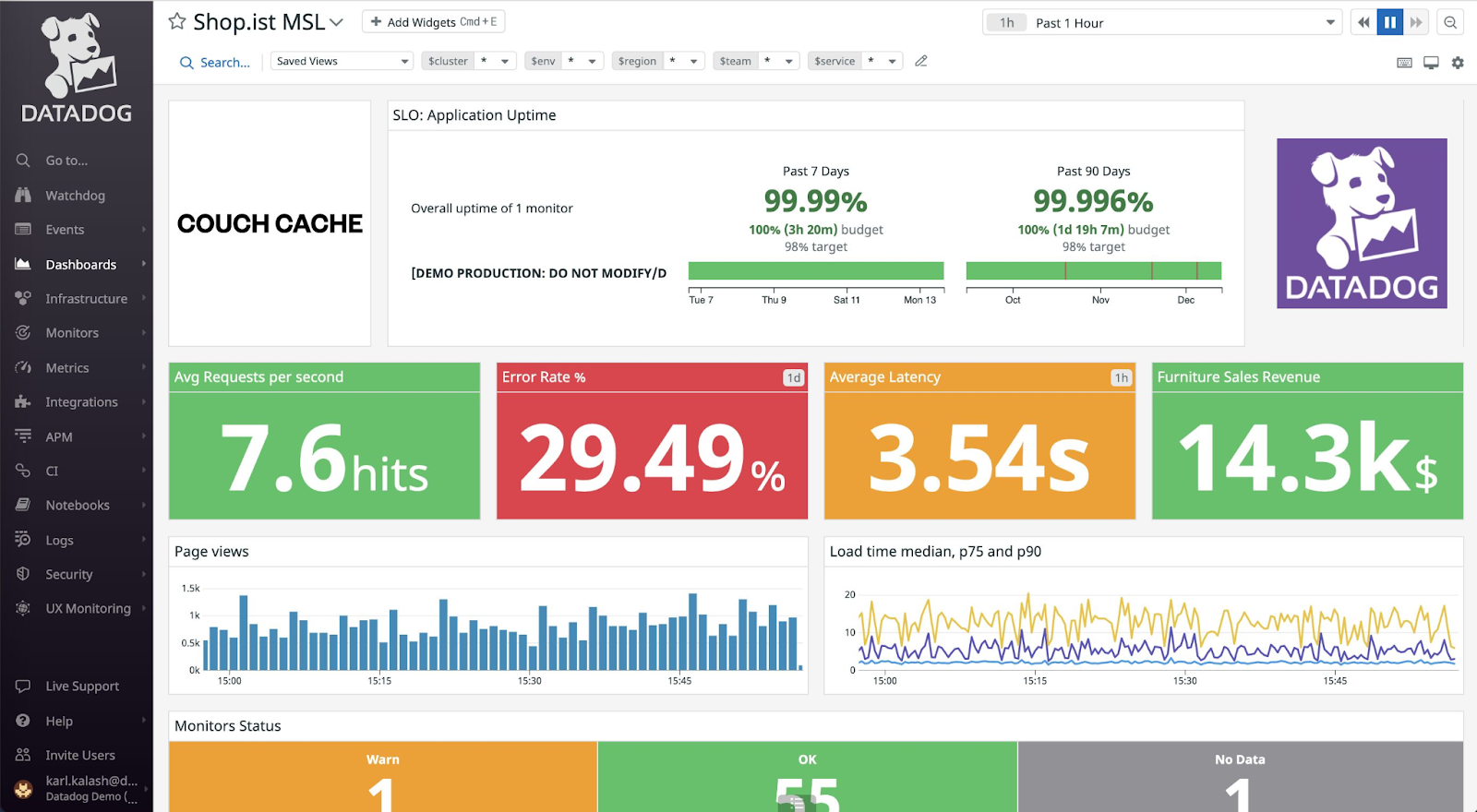
8. Datadog

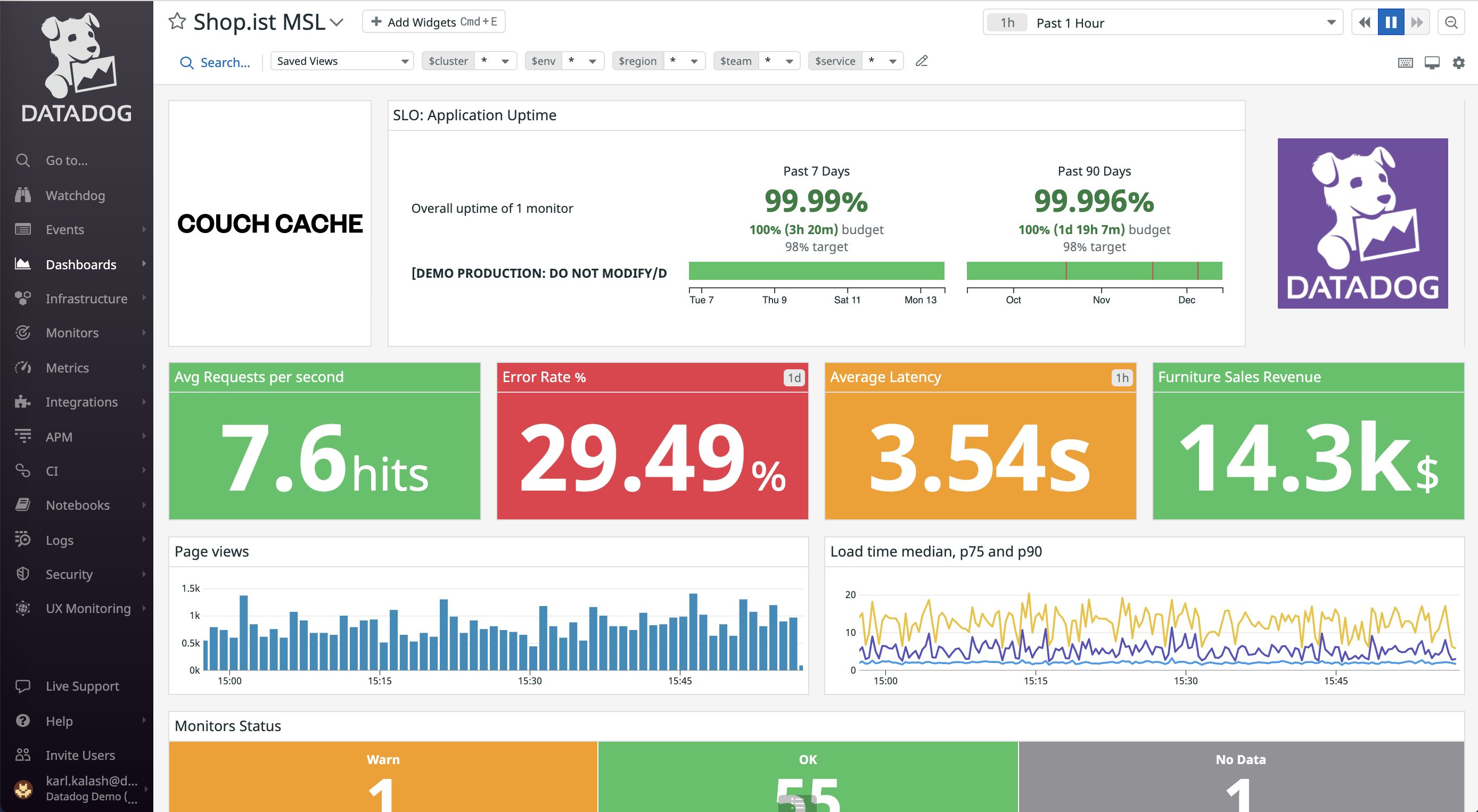
Datadog Cloud Cost Management extends an observability platform with FinOps capabilities, combining cost and performance data. It allows engineering and finance teams to collaborate by providing cost visibility within existing monitoring workflows, enabling more informed optimization decisions.
Key features:
- Cost and performance integration: Combines infrastructure metrics with cost data for context-aware analysis
- Cost allocation: Attributes cloud and SaaS spend to teams, services, and products, including shared resources
- Automated optimization: Provides recommendations and supports automation for resource optimization
- Anomaly detection and alerts: Monitors spending patterns and alerts teams to unusual changes
- Collaboration and reporting: Offers dashboards, notebooks, and exportable reports to support cross-team alignment
Source: Datadog
Conclusion
Harness Cloud Cost Management is one option for optimizing cloud usage at scale. However, organizations should weigh its costs and complexity against their internal capabilities and priorities. As with any FinOps solution, the value depends on how well it integrates into existing workflows and how effectively teams can use its insights to drive change.
See Additional Guides on Key FinOps Topics
Together with our content partners, we have authored in-depth guides on several other topics that can also be useful as you explore the world of FinOps.
Virtual Desktop Infrastructure
Authored by Venn
- [Guide] Best VDI Solutions: Top 8 to Know in 2026
- [Guide] What is VDI? Virtual Desktop Infrastructure
- [Guide] VDI vs. RDP: 5 Differences, Pros/Cons & Alternative Approaches
Snowflake Pricing
Authored by Finout
- [Guide] 9 Components of Snowflake Pricing: Complete 2025 Guide
- [Guide] 7 Snowflake Cost Reduction Strategies
- [Webinar] Driving a Successful Company-Wide FinOps Cultural Change
- [Product] Finout | Enterprise-Grade FinOps Platform
Cloud Cost Optimization
Authored by Finout

.svg)